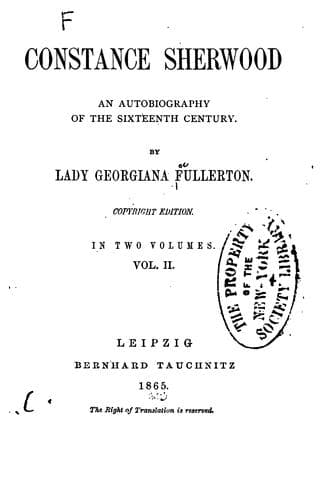
Constance Sherwood: An Autobiography of the Sixteenth CenturyFullerton, Georgiana
History
Constance Sherwood: An Autobiography of the Sixteenth Century
Fullerton, Georgiana
Great Britain -- History -- Elizabeth, 1558-1603 -- Fiction
One lady called out in a loud voice that Papists, and such as take
their part, among which she did lament to see Mr. Roper, should be
ashamed so much as to speak of persecution; and began to relate the
cruelties practised upon Protestants twenty years back, and the
burning at Oxford of those excellent godly men, the bishops of London
and Worcester.
Mr. Roper listened to her with an attentive countenance, and then
said:
"I' faith, madam, I cannot choose but think Dr. Latimer, if it be he
you speak of, did somewhat approve of such a method of dealing with
persons obstinate touching religion, when others than himself and
those of his own way of thinking were the subjects of it, if we judge
by a letter he wrote in 1538 to his singular good friend the Lord
Privy Seal Cromwell, at the time he was appointed to preach at the
burning at Smithfield of Friar Forest of Greenwich, a learned divine I
often did converse with in my young years."
"What wrote the good bishop?" two or three persons asked; and the lady
who had spoken before said she should warrant it to be something
pious, for a more virtuous Protestant never did live than this holy
martyr.
Whereupon Mr. Roper: "This holy bishop did open his discourse right
merrily, for in a pleasant manner he thus begins his letter: 'And,
sir, if it be your pleasure, as it is, that I shall play the fool in
my customable manner when Forest shall suffer, I would wish my stage
stood near unto Forest; for I would endeavor myself so to content the
people that therewith I might also convert Forest, God so helping.'
And further on he doth greatly lament that the White Friars of
Doncaster had access to the prisoner, and through the fault of the
sheriff or jailers, or both, he should be allowed to hear mass and
receive the sacrament, by which he is rather comforted in his way than
discouraged. And _such is his foolishness_, this good doth
humbly say, that if Forest would abjure his religion, he should yet
(for all his past obstinacy) wish him pardoned. O sirs, think you that
when at Oxford this aged man, seventeen years after, did see the
flames gather round himself, that he did not call to mind what time he
preached, playing the fool, as he saith, before a man in like agonies,
and never urged so much as one word against his sentence?"
"Marry, if he did not," said one, whom I take to have been Sir
Christopher Wray, who had been a silent listener until then, "if his
conscience pricked him not thereon, it must needs have been by the
same rule as the lawyer used to the countryman, who did put to him
this question: 'Sir, if my cow should stray into your field and feed
there one whole day, what should be the law touching compensation
therefor?' 'Marry, friend, assuredly to pay the damage to the full,
which thou art bounden at once to do.' 'Ay,' quoth the countryman;
'but 'tis your cow hath strayed into my field.' Upon which, 'Go to, go
to,' cries the lawyer; 'for I warrant thee that doth altogether alter
the law.'"
Public-domain text, read in full here on John Shaqi.
Reviews
Reviews
No reviews yet
Be the first to share your thoughts on this work.
Elsewhere in the archive
Join the Discussion
Join the discussion
Sign in to leave a comment or review.
Sign InorCreate an account