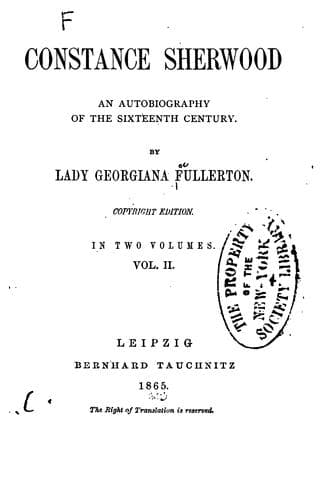
Constance Sherwood: An Autobiography of the Sixteenth CenturyFullerton, Georgiana
History
Constance Sherwood: An Autobiography of the Sixteenth Century
Fullerton, Georgiana
Great Britain -- History -- Elizabeth, 1558-1603 -- Fiction
Mr. and Mrs. Genings were of the religion by law established. He was
thought to be Catholic at heart; albeit he was often heard to speak
very bitterly against all who obeyed not the queen in conforming to
the new mode of worship, with the exception, indeed, of my mother, for
whom he had always a truly great affection. This gentleman's house was
in the close of the cathedral, and had a garden to it well stored with
fair shrubs and flowers of various sorts. As I lay on a low settle
near the window, being forbid to walk for the space of three weeks, my
eyes were ever straying from my sampler to the shade and sunshine out
of doors. Instead of plying at my needle, I watched the bees at their
sweet labor midst the honeysuckles of the porch, or the swallows
darting in and out of the eaves of the cathedral, or the butterflies
at their idle sports over the beds of mignonette and heliotrope under
the low wall, covered with ivy, betwixt the garden and the close. Mr.
Genings had two sons, the eldest of which was some years older and the
other younger than myself. The first, whose name was Edmund, had been
weakly when a child, and by reason of this a frequent sojourner at
Sherwood Hall, where he was carried for change of air after the many
illnesses incident to early age. My mother, who was some years married
before she had a child of her own, conceived a truly maternal
affection for this young kinsman, and took much pains with him both as
to the care of his body and the training of his mind. He was an apt
pupil, and she had so happy a manner of imparting knowledge, that he
learnt more, as he has since said, in those brief sojourns in her
house than at school from more austere masters. After I came into the
world, he took delight to rock me in my cradle, or play with me as I
sat on my mother's knee; and when I first began to walk, he would lead
me by the hand into the garden, and laugh to see me clutch marigolds
or cry for a sunflower.
"I warrant thou hast an eye to gold, Con," he would say; "for 'tis the
yellow flowers that please thee best."
There is an old hollow tree on the lawn at Sherwood Hall where I often
hid from him in sport, and he would make pretence to seek me
elsewhere, till a laugh revealed me to him, and a chase ensued down
the approach or round the maze. He never tired of my petulance, or
spoke rude words, as boys are wont to do; and had a more serious and
contemplative spirit than is often seen in young people, and likewise
a singular fancy for gazing at the sky when glowing with sunset hues
or darkened by storms, and most of all when studded at night with
stars. On a calm clear night I have noticed him for a length of time,
forgetting all things else, fix his eyes on the heavens, as if reading
the glory of the Lord therein revealed.
Public-domain text, read in full here on John Shaqi.
Reviews
Reviews
No reviews yet
Be the first to share your thoughts on this work.
Join the Discussion
Join the discussion
Sign in to leave a comment or review.
Sign InorCreate an account