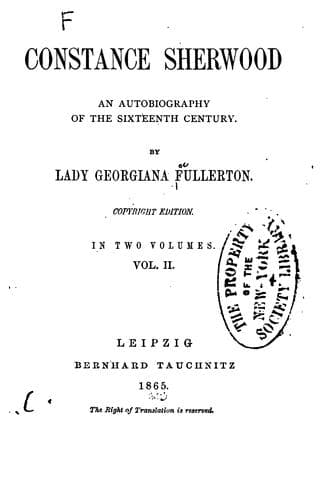
Constance Sherwood: An Autobiography of the Sixteenth CenturyFullerton, Georgiana
History
Constance Sherwood: An Autobiography of the Sixteenth Century
Fullerton, Georgiana
Great Britain -- History -- Elizabeth, 1558-1603 -- Fiction
"No," she replied; "I purpose never more to leave my Lord Arundel or
my Lady Lumley as long as they do live, which I pray God may be many
years."
And then she sat without speaking, biting her lips and wringing the
kerchief she held in her hands, as if to keep her grief from
outbursting. I dared not to comment on her resolve, for I foresaw that
the least word which should express some partaking of her sorrow, or
any question relating to it, would let loose a torrent weakly stayed
by a mightful effort, not like to be of long avail. So I spoke of mine
own troubles, and the events which had occasioned my sudden departure
from Lynn Court. She had heard of Lady l'Estrange's mishap, and that
the following day I had journeyed to London; but naught of the causes
thereof, or of the apprehension of any priest by Sir Hammond's orders.
Which, when she learnt the manner of this misfortune, and the poor
lady's share therein, and that it was my father she had thus
unwittingly discovered, her countenance softened, and throwing her
arms round my neck, she bitterly wept, which at that moment methinks
did her more good than anything else.
"Oh, mine own good Constance," she said, "I doubt not nature riseth
many passionate workings in your soul at this time; but, my dear
wench, when good men are in trouble our grief for them should be as
noble as their virtues. Bethink thee what a worst sorrow it should be
to have a vile father, one that thou must needs love,--for who can
tear out of his heart affection strong as life?--and he should then
prove unworthy. Believe me, Constance, God gives to each, even in this
world, a portion of their deserts. Such griefs as thy present one I
take to be rare instances of his favor. Other sorts of trials are meet
for cowardly souls which refuse to set their lips to a chalice of
suffering, and presently find themselves submerged in a sea of woes.
But can I help thee, sweet one? Is there aught I can do to lighten thy
affliction? Hast thou license for to see thy father?"
"No, dear lady," I answered; "and his name being concealed, I may not
petition as his daughter for this permission; but if my Lord Arundel
should be so good a lord to me as to obtain leave for me to visit this
prisoner, without revealing his name and condition, he should do me
the greatest benefit in the world."
Public-domain text, read in full here on John Shaqi.
Reviews
Reviews
No reviews yet
Be the first to share your thoughts on this work.
Elsewhere in the archive