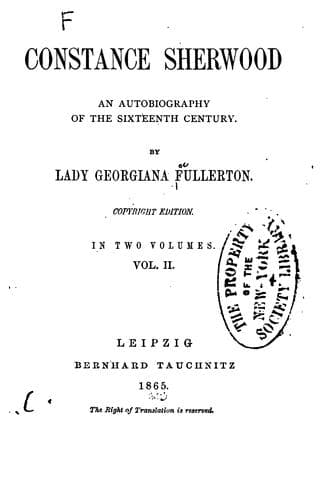
Constance Sherwood: An Autobiography of the Sixteenth CenturyFullerton, Georgiana
History
Constance Sherwood: An Autobiography of the Sixteenth Century
Fullerton, Georgiana
Great Britain -- History -- Elizabeth, 1558-1603 -- Fiction
"I will move him thereunto," my lady said. "But he who had formerly no
equal in the queen's favor, and to whom she doth partly owe her crown,
is now in his sickness and old age of so little account in her eyes,
that trifling favors are often denied him to whom she would once have
said: 'Ask of me what thou wilt, and I will give it unto thee.' But
what my poor endeavors can effect through him or others shall not be
lacking in this thy need. But I am not in that condition I was once
like to have enjoyed." Then with her eyes cast on the ground she
seemed for to doubt if she should speak plainly, or still shut
up her grief in silence. As I sat painfully expecting her next words,
the door opened, and two ladies were announced, which she whispered in
mine ear she would fain not have admitted at that time, but that Lord
Arundel's desire did oblige her to entertain them. One was Mistress
Bellamy, and the other her daughter, Mistress Frances, a young
gentlewoman of great beauty and very lively parts, which I had once
before seen at Lady Ingoldsby's house. She was her parents' sole
daughter, and so idolized by them that they seemed to live only to
minister to her fancies. Lord Arundel was much bounden to this family
by ancient ties of friendship, which made him urgent with his
granddaughter that she should admit them to her privacy. I admired in
this instance how suddenly those which have been used to exercise such
self-command as high breeding doth teach can school their exterior to
seem at ease, and even of good cheer, when most ill at ease
interiorly, and with hearts very heavy. Lady Surrey greeted these
visitors with as much courtesy, and listened to their discourse with
as much civility and smiles when called for, as if no burthensome
thoughts did then oppress her.
Many and various themes were touched upon in the random talk which
ensued. First, that wonted one of the queen's marriage, which some
opined should verily now take place with Monsieur d'Alençon; for that
since his stealthy visits to England, she did wear in her bosom a
brooch of jewels in a frog's shape.
"Ay," quoth Mistress Frances, "that stolen visit which awoke the ire
of the poor soul Stubbs, who styled it 'an unmanlike, unprincelike,
French kind of wooing,' and endeth his book of 'The Gaping Gulph' in a
loyal rage: 'Here is, therefore, an imp of the crown of France, to
marry the crowned nymph of England,'--a nymph indeed well stricken in
years. My brother was standing by when Stubbs' hand was cut off; for
nothing else would content that sweet royal nymph, albeit the lawyers
stoutly contended the statute under which he suffered to be null and
void. As soon as his right hand is off, the man takes his hat off with
the left, and cries 'God bless the queen!'"
"Here is a wonder," I exclaimed; "I pray you, what is the art this
queen doth possess by which she holdeth the hearts of her subjects in
so great thrall, albeit so cruel to them which do offend her?"
Public-domain text, read in full here on John Shaqi.
Reviews
Reviews
No reviews yet
Be the first to share your thoughts on this work.
Elsewhere in the archive
Join the Discussion
Join the discussion
Sign in to leave a comment or review.
Sign InorCreate an account