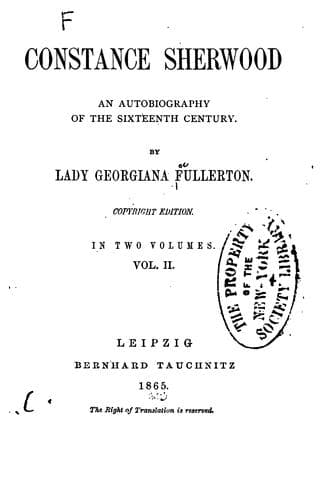
Constance Sherwood: An Autobiography of the Sixteenth CenturyFullerton, Georgiana
History
Constance Sherwood: An Autobiography of the Sixteenth Century
Fullerton, Georgiana
Great Britain -- History -- Elizabeth, 1558-1603 -- Fiction
The visit I have described had lasted some time, when a servant came
with a message to her ladyship from Mr. Hubert Rookwood, who craved to
be admitted on an urgent matter. She glanced at me somewhat surprised,
upon which I made her a sign that she should condescend to his
request; for I supposed he had seen Sir Francis Walsingham, and was in
haste to confer with me touching that interview; and she ordered him
to be admitted. Mrs. Bellamy and her daughter rose to go soon after
his entrance; and whilst Lady Surrey conducted them to the door he
asked me if her ladyship was privy to the matter in hand. When I had
satisfied him thereof, he related what had passed in an interview he
had with Sir Francis, whom he found ill-disposed at first to stir in
the matter, for he said his frequent remonstrances in favor of
recusants had been like to bring him into odium with some of the more
zealous Protestants, and that he must needs, in every case of that
sort, prove it to be his sole object to bring such persons more
surely, albeit slowly, by means of toleration, to a rightful
conformity; and that with regard to priests he was very loth to
interfere.
"I was compelled," quoth Hubert, "to use such arguments as fell in
with the scope of his discourse, and to flatter him with the hope of
good results in that which he most desired, if he would procure Mr.
Sherwood's release, which I doubt not he hath power to effect. And in
the end he consented to lend his aid therein, on condition he should
prove on his side so far conformable as to suffer a minister to visit
and confer with him touching religion, which would then be a pretext
for his release, as if it were supposed he was well disposed toward
Protestant religion, and a man more like to embrace the truth when at
liberty than if driven to it by stress of confinement. Then he would
procure," he added, "an order for his passage to France, if he
promised not to return, except he should be willing to obey the laws."
"I fear me much," I answered, "my father will not accept these terms
which Sir Francis doth offer. Methinks he will consider they do
involve some lack of the open profession of his faith."
"It would be madness for one in his plight to refuse them," Hubert
exclaimed, and appealed thereon to Lady Surrey, who said she did
indeed think as he did, for it was not like any better could be
obtained.
It pained me he should refer to her, who from conformity to the times
could not well conceive how tender a Catholic conscience should feel
at the least approach to dissembling on this point.
"Wherein," he continued, "is the harm for to confer with a minister,
or how can it be construed into a denial of a man's faith to listen to
his arguments, unless, indeed, he feels himself to be in danger of
being shaken by them?"
Public-domain text, read in full here on John Shaqi.
Reviews
Reviews
No reviews yet
Be the first to share your thoughts on this work.
Elsewhere in the archive
Join the Discussion
Join the discussion
Sign in to leave a comment or review.
Sign InorCreate an account