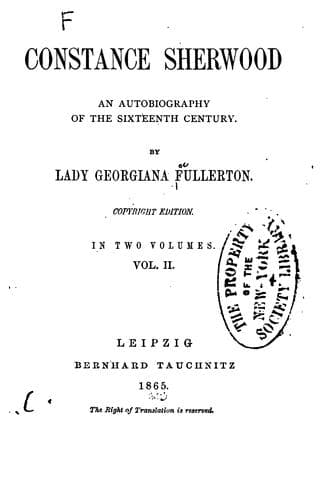
Constance Sherwood: An Autobiography of the Sixteenth CenturyFullerton, Georgiana
History
Constance Sherwood: An Autobiography of the Sixteenth Century
Fullerton, Georgiana
Great Britain -- History -- Elizabeth, 1558-1603 -- Fiction
I made no reply to this last speech; for albeit I thought my father
would not accede to these terms, I did not so far trust mine own
judgment thereon as to predict with certainty what his answer should
be. And then Hubert said he had an order from Sir Francis that would
admit me on the morrow to see my father; and he offered to go with me,
and Mistress Ward too, if I listed, to present it, albeit I alone
should enter his cell. I thanked him, and fixed the time of our going.
When he had left us, Lady Surrey commended his zeal, and also his
moderate spirit, which did charitably allow, she said, for such as
conformed to the times for the sake of others which their
reconcilement would very much injure.
Before I could reply she changed this discourse, and, putting her
hands on my shoulders and kissing my forehead, said,
"My Lady Lumley hath heard so much from her poor niece of one
Mistress Constance Sherwood, that she doth greatly wish to see this
young gentlewoman and very resolved papist." And then taking me by the
arm she led me to that lady's chamber, where I had as kind a welcome
as ever I received from any one from her ladyship, who said "her dear
Nan's friends should be always as dear to her as her own," and added
many fine commendations greatly exceeding my deserts.
CHAPTER XVII.
When I had been a short time in my Lady Lumley's chamber, my Lord
Arundel sent for his granddaughter, who was wont, she told me, at that
hour to write letters for him; and I stayed alone with her ladyship,
who, as soon as Lady Surrey left us, thus broke forth in her praise:
"Hath any one, think you. Mistress Sherwood, ever pictured or imagined
a creature more noble, more toward in disposition, more virtuous in
all her actions, of greater courage in adversity or patience under
ill-usage than this one, which God hath sent to this house to cheer
two lonely hearts, whilst her own is well-nigh broken?"
"Oh, my Lady Lumley!" I exclaimed, "I fear some new misfortune hath
befallen this dear lady, who is indeed so rare a piece of goodness
that none can exceed in describing her deserts. Hitherto she hath
condescended to impart her sorrows to her poor friend; but to-day she
shut up her griefs in her own bosom, albeit I could read unspoken
suffering in every lineament of her sweet countenance."
"God forgive me," her ladyship replied, "if in speaking of her wrongs
I should entertain over-resentful feelings toward her ungracious
husband, whom once I did love as a mother, and very loth hath my heart
been to condemn him; but now, if it were not that I myself received
him in my arms what time he was born, whose life was the cause of my
sweet young sister's death, I should doubt he could be her son."
"What fresh injury," I timidly asked, "hath driven Lady Surrey from
her house?"
Public-domain text, read in full here on John Shaqi.
Reviews
Reviews
No reviews yet
Be the first to share your thoughts on this work.
Elsewhere in the archive
Join the Discussion
Join the discussion
Sign in to leave a comment or review.
Sign InorCreate an account