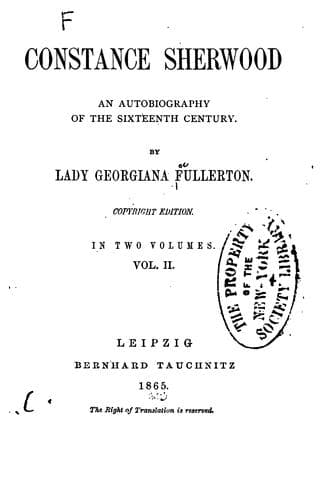
Constance Sherwood: An Autobiography of the Sixteenth CenturyFullerton, Georgiana
History
Constance Sherwood: An Autobiography of the Sixteenth Century
Fullerton, Georgiana
Great Britain -- History -- Elizabeth, 1558-1603 -- Fiction
writ that unbeseeming word, and I will e'en draw a line across it,
but still as you may read it for indeed 'tis what he is; but 'tis
from himself I learnt it, who in his sermons calls Catholic religion
a pestilent idolatry, and Catholic priests pestilent teachers and
servants of Antichrist, and the holy Pope at Rome the man of sin)
she grows uneasy, and bids me be a good child to her, and not to
bring her into trouble with his grace, who is indeed a very good
lord to us in all matters but that one of compelling us to hear
sermons and the like. My Lord Surrey mislikes all kinds of sermons,
and loves Mr. Martin so well, that he stops his ears when Mr. Fox
preaches on the dark midnight of papacy and the dawn of the gospel's
restored light. And it angers him, as well it should, to hear him
call his majesty King Philip of Spain, who is his own godfather,
from whom he received his name, a wicked popish tyrant and a son of
Antichrist. My Lady Margaret, his sister, who is a year younger than
himself, and has a most admirable beauty and excellent good nature,
is vastly taken with what she hears from me of Catholic religion;
but methinks this is partly by reason of her misliking Mr. Fulk and
Mr. Clarke's long preachments, which we are compelled to hearken to;
and their fashion of spending Sunday, which they do call the
Sabbath-day, wherein we must needs keep silence, and when not in
church sit still at home, which to one of her lively disposition is
heavy penance. Methinks when Sunday comes we be all in disgrace;
'tis so like a day of correction. My Lord Surrey has more liberty;
for Mr. Martin carries him and his brothers after service into the
pleasant fields about Westminster Abbey and the village of Charing
Cross, and suffers them to play at ball under the trees, so they do
not quarrel amongst themselves. My Lord Henry Howard, his grace's
brother, always maintains and defends the Catholic religion against
his sister of Westmoreland; and he spoke to my uncles Leonard,
Edward, and Francis, and likewise to my aunt Lady Montague, that
they should write unto my grandmother touching his grace bringing us
up as Protestants. But the Duke of Norfolk, Mrs. Fawcett says, is
our guardian, and she apprehends he is resolved that we shall
conform to the times, and that no liberty be allowed us for the
exercise of Catholic religion."
At this part of the letter I stopped reading; and Edmund, turning to
my father, who, though he before had perused it, was also listening,
said: "And if this be liberty of conscience, which Protestants speak
of, I see no great liberty and no great conscience in the matter."
His cheek flushed as he spoke, and there was a hoarseness in his voice
which betokened the working of strong feelings within him. My father
smiled with a sort of pitiful sadness, and answered:
Public-domain text, read in full here on John Shaqi.
Reviews
Reviews
No reviews yet
Be the first to share your thoughts on this work.
Join the Discussion
Join the discussion
Sign in to leave a comment or review.
Sign InorCreate an account