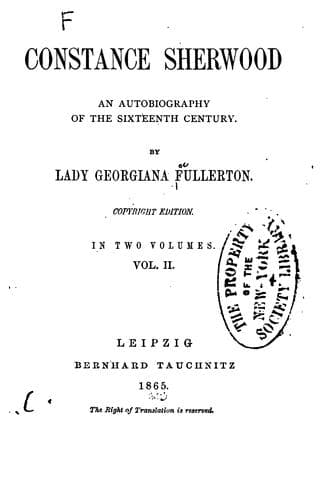
Constance Sherwood: An Autobiography of the Sixteenth CenturyFullerton, Georgiana
History
Constance Sherwood: An Autobiography of the Sixteenth Century
Fullerton, Georgiana
Great Britain -- History -- Elizabeth, 1558-1603 -- Fiction
"My dear," the good man answered, "God knoweth 'tis no easy matter to
attain to the courage you speak of. I have myself seen the sweetest,
the lovingest, and the most brave creature which ever did breathe give
marks of extraordinary sorrow when her father, that generous martyr of
Christ, was to die."
"I pray you tell me," I answered, "what her behavior was like in that
trial; for to converse on such themes doth allay somewhat the torment
of suspense, and I may learn lessons from her example, who, you say,
joined to natural weakness so courageous a spirit in like straits."
Upon which he, willing to divert and yet not violently change the
current of my thoughts, spake as followeth:
"On the day when Sir Thomas More came from Westminster to the
Tower-ward, my wife, desirous to see her father, whom she thought she
should never see in this world after, and also to have his final
blessing, gave attendance about the wharf where she knew he should
pass before he could enter into the Tower. As soon as she saw him,
after his blessing upon her knees reverently received, hastening
toward him without care or consideration of herself, passing in
amongst the throng and company of the guard, she ran to him and took
him about the neck and kissed him; who, well liking her most natural
and dear daughterly affection toward him, gave her his fatherly
blessing and godly words of comfort beside; from whom, after she was
departed, not satisfied with the former sight of him, and like one
that had forgotten herself, being all ravished with the entire love of
her father, suddenly turned back again, ran to him as before, took him
about the neck, and divers times kissed him lovingly, till at last,
with a full and heavy heart, she was fain to depart from him; the
beholding thereof was to many that were present so lamentable, and
mostly so to me, that for very sorrow we could not forbear to weep
with her. The wife of John Harris, Sir Thomas's secretary, was moved
to such a transport of grief, that she suddenly flew to his neck and
kissed him, as he had reclined his head on his daughter's shoulder;
and he who, in the midst of the greatest straits, had ever a merry
manner of speaking, cried, 'This is kind, albeit rather unpolitely
done.'"
"And the day he suffered," I asked, "what was this good daughter's
behavior?"
Public-domain text, read in full here on John Shaqi.
Reviews
Reviews
No reviews yet
Be the first to share your thoughts on this work.
Elsewhere in the archive
Join the Discussion
Join the discussion
Sign in to leave a comment or review.
Sign InorCreate an account