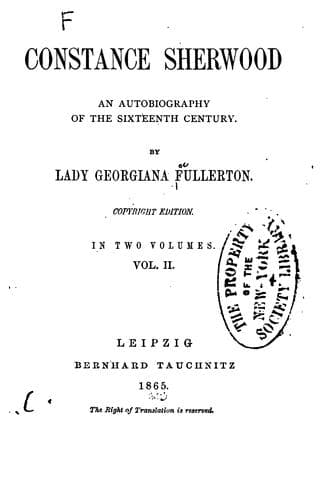
Constance Sherwood: An Autobiography of the Sixteenth CenturyFullerton, Georgiana
History
Constance Sherwood: An Autobiography of the Sixteenth Century
Fullerton, Georgiana
Great Britain -- History -- Elizabeth, 1558-1603 -- Fiction
"She went," quoth he, "to the different churches, and distributed
abundant alms to the poor. When she had given all her money away, she
withdrew to pray in a certain church, where she on a sudden did
remember she had no linen in which to wrap up her father's body. She
had heard that the remains of the Bishop of Rochester had been thrown
into the ground, without priest, cross, lights, or shroud, for the
dread of the king had prevented his relations from attempting to bury
him. But Margaret resolved her father's body should not meet with such
unchristian treatment. Her maid advised her to buy some linen in the
next shop, albeit having given away all her money to the poor, there
was no likelihood she should get credit from strangers. She ventured,
howsoever, and having agreed about the price, she put her hand in her
pocket, which she knew was empty, to show she forgot the money, and
ask credit under that pretence. But to her surprise, she found in her
purse the exact price of the linen, neither more or less; and so
buried the martyr of Christ with honor, nor was there any one so
inhuman found as to hinder her."
"Mr. Roper," I said, when he had ended his recital, "methinks this
angelic lady's trial was most hard: but how much harder should it yet
have been if you, her husband, had been in a like peril at that time
as her father?"
A half kind of melancholy, half smiling look came into the good old
man's face as he answered:
"Her father was Sir Thomas More, and he so worthy of a daughter's
passionate love, and the affection betwixt them so entire and
absolute, compounded of filial love on her part, unmitigated
reverence, and unrestrained confidence, that there was left in her
heart no great space for wifely doating. But to be moderately
affectioned by such a woman, and to stand next in her esteem to her
incomparable father, was of greater honor and worth to her unworthy
husband, than should have been the undivided, yea idolatrous, love of
one not so perfect as herself."
After a pause, during which his thoughts, I ween, reverted to the
past, and mine investigated mine own soul, I said to Mr. Roper:
Public-domain text, read in full here on John Shaqi.
Reviews
Reviews
No reviews yet
Be the first to share your thoughts on this work.
Elsewhere in the archive
Join the Discussion
Join the discussion
Sign in to leave a comment or review.
Sign InorCreate an account