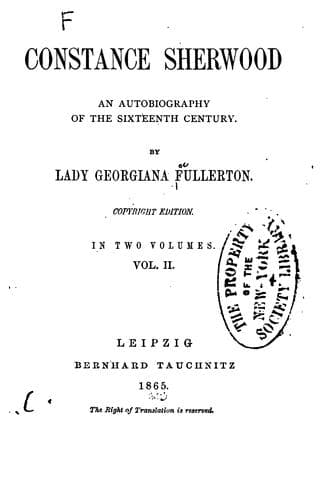
Constance Sherwood: An Autobiography of the Sixteenth CenturyFullerton, Georgiana
History
Constance Sherwood: An Autobiography of the Sixteenth Century
Fullerton, Georgiana
Great Britain -- History -- Elizabeth, 1558-1603 -- Fiction
"Think you, sir, that love to be idolatrous which is indeed so
absolute that it should be no difficulty to die for him who doth
inspire it; which would prefer a prison in his company, howsoever dark
and loathsome (yea consider it a very paradise), to the beautifullest
palace in the world, which without him would seem nothing but a vile
dungeon; which should with a good-will suffer all the torments in the
world for to see the object of its affection enjoy good men's esteem
on earth, and a noble place in heaven; but which should be,
nevertheless, founded and so wholly built up on a high estimate of his
virtues; on the quality he holdeth of God's servant; on the likeness
of Christ stamped on his soul, and each day exemplified in his manner
of living, that albeit to lose his love or his company in this world
should be like the uprooting of all happiness and turning the
brightness of noonday to the darkness of the night, it should a
thousand times rather endure this mishap than that the least shade or
approach of a stain should alter the unsullied opinion till then held
of his perfections?"
Mr. Roper smiled, and said that was a too weighty question to answer
at once; for he should be loth to condemn or yet altogether to absolve
from some degree of overweeningness such an affection as I described,
which did seem indeed to savor somewhat of excess; but yet if noble in
its uses and held in subjection to the higher claims of the Creator,
whose perfections the creature doth at best only imperfectly mirror,
it might be commendable and a means of attaining ourselves to the like
virtues we doated on in another.
As he did utter these words a servant came into the parlor, and
whispered in mine ear:
"Master Basil Rookwood is outside the door, and craves--"
I suffered him not to finish his speech, but bounded into the hall,
where Basil was indeed standing with a traveller's cloak on him, and a
slouched hat over his face. After such a greeting as may be conceived
(alas, all greetings then did seem to combine strange admixtures of
joy and pain!), I led him into the parlor, where Mr. Roper in his turn
received him with fatherly words of kindness mixed with amazement at
his return.
"And whence," he exclaimed, "so sudden a coming, my good Basil?
Verily, you do appear to have descended from the skies!"
Basil looked at me and replied: "I heard in Paris, Mr. Roper, that a
gentleman in whom I do take a very lively interest, one Mr. Tunstall,
was in prison at London; and I bethought me I could be of some service
to him by coming over at this time."
"O Basil," I cried, "do you then know he is my father?"
Public-domain text, read in full here on John Shaqi.
Reviews
Reviews
No reviews yet
Be the first to share your thoughts on this work.
Elsewhere in the archive
Join the Discussion
Join the discussion
Sign in to leave a comment or review.
Sign InorCreate an account