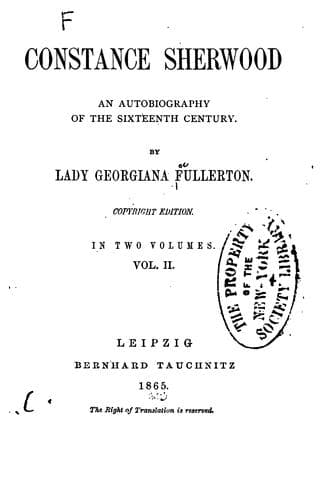
Constance Sherwood: An Autobiography of the Sixteenth CenturyFullerton, Georgiana
History
Constance Sherwood: An Autobiography of the Sixteenth Century
Fullerton, Georgiana
Great Britain -- History -- Elizabeth, 1558-1603 -- Fiction
"I fear me, sir," he cried, clasping his hands, "I befear me much I
have affrighted you, and I have been myself sorely affrighted. I was
passing through this room, which I have never before seen, and the
door of which was open this morn. By chance I drew my hand along the
wall, where there was no apparent mark, when the panel slipped and
disclosed this recess, into which I stepped, and straightway the
opening closed and I remained in darkness. I was afraid no one might
hear me, and I should die of hunger."
My father tried to smile, but could not. "Thank God," he said, "'tis
no worse;" and sinking down on a chair he remained silent, whilst the
sheriff and the pursuivants examined the recess, which was deep and
narrow, and in which they brandished their swords in all directions.
Then they went round the room, feeling the walls; but though there was
another recess with a similar mode of aperture, they hit not on it,
doubtless through God's mercy; for in it were concealed the altar
furniture and our books, with many other things besides, which they
would have seized on.
Before going away, the sheriff questioned Edmund concerning his faith,
and for what reason he abode in a Popish house and consorted with
recusants. Edmund answered he was no Papist, but a kinsman of Mrs.
Sherwood, unto whose house his father had oftentimes sent him. Upon
which he was counselled to take heed unto himself and to eschew evil
company, which leads to horrible defections, and into the straight
road to perdition. Whereupon they departed; and the officer who had
enticed his companion from the library smiled as he passed me, and
said:
"And wherefore not at prayers, little mistress, on the Lord's day, as
all Christian folks should be?"
I ween he was curious to see how I should answer, albeit not moved
thereunto by any malicious intent. But at the time I did not bethink
myself that he spoke of Protestant service; and being angered at what
passed, I said:
"Because we be kept from prayers by the least welcome visit ever made
to Christian folks on a Lord's morning." He laughed and cried:
"Thou hast a ready tongue, young mistress; and when tried for
recusancy I warrant thou'lt give the judge a piece of thy mind."
"And if I ever be in such a presence, and for such a cause," I
answered, "I pray to God I may say to my lord on the bench what the
blessed apostle St. Peter spoke to his judges: 'If it be just in the
sight of God to hear you rather than God, judge ye.'" At which he
cried:
"Why, here is a marvel indeed--a Papist to quote Scripture!" And
laughing again, he went his way; and the house was for that time rid
of these troublesome guests.
Then Edmund again sued for pardon to my father, that through his rash
conduct he had been the occasion of so great fear and trouble to him.
Public-domain text, read in full here on John Shaqi.
Reviews
Reviews
No reviews yet
Be the first to share your thoughts on this work.
Join the Discussion
Join the discussion
Sign in to leave a comment or review.
Sign InorCreate an account