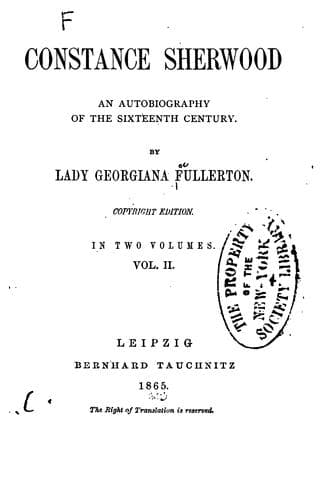
Constance Sherwood: An Autobiography of the Sixteenth CenturyFullerton, Georgiana
History
Constance Sherwood: An Autobiography of the Sixteenth Century
Fullerton, Georgiana
Great Britain -- History -- Elizabeth, 1558-1603 -- Fiction
"Yea, for mine," Polly answered; "or else for M. de la Motte's, who
came in to pay his devoirs to her, for the first time, I take it,
since her lord's death. And after his first speech, which caused her
to weep a little, he did carry on so brisk a discourse as I never
noticed any but a Frenchman able to do. And she was not the worst
pleased with it that the cunning gentleman did interweave it with
anecdotes of the queen's majesty; which, albeit he related them with
gravity, did carry somewhat of ridicule in them. Such as of her
grace's dancing on Sunday before last at Lord Northampton's wedding,
and calling him to witness her paces, so that he might let
monsieur know how high and disposedly she danced; so that he would not
have had cause to complain, in case he had married her, that she was a
boiteuse, as had been maliciously reported of her by the friends of
the Queen of Scots. And also how, some days since, she had flamed out
in great choler when he went to visit her at Hampton Court; and told
him, so loud that all her ladies and officers could hear her
discourse, that Lord North had let her know the queen-mother and the
Duke of Guise had dressed up a buffoon in an English fashion, and
called him a Milor du Nord; and that two female dwarfs had been
likewise dressed up in that queen's chamber, and invited to mimic her,
the queen of England, with great derision and mockery. 'I did assure
her,' M. de la Motte said, 'with my hand on my heart, and such an
aggrieved visage, that she must needs have accepted my words as true,
that Milor North had mistaken the whole intent of what he had
witnessed, from his great ignorance of the French tongue, which did
render him a bad interpreter between princes; for that the
queen-mother did never cease to praise her English majesty's beauty to
her son, and all her good qualities, which greatly appeased her grace,
who desired to be excused if she, likewise out of ignorance of the
French language, had said aught unbecoming touching the queen-mother.'
'Tis a rare dish of fun, fit to set before a king, to hear this
Monsieur Ambassador speak of the queen when none are present but such
as make an idol of her, as some do."
"For my part," said her father, when she paused in her speech, "I
mislike men with double visages and double tongues; and methinks this
monseer hath both, and withal a rare art for what courtiers do call
diplomacy, and plain men lying. His speeches to her majesty be so
fulsome in her praise, as I have heard some say who are at court, and
his flattery so palpable, that they have been ashamed to hear it; but
behind her back he doth disclose her failings with an admirable
slyness."
"If he be sly," answered Polly, "I'll warrant he finds his match in
her majesty."
"Yea," cried Kate, "even as poor Madge Arundell experienced to her
cost."
"Ay," quoth Polly, "she catcheth many poor fish, who little know what
snare is laid for them."
"And how did her highness catch Mistress Arundell?" I asked.
Public-domain text, read in full here on John Shaqi.
Reviews
Reviews
No reviews yet
Be the first to share your thoughts on this work.
Elsewhere in the archive
Join the Discussion
Join the discussion
Sign in to leave a comment or review.
Sign InorCreate an account