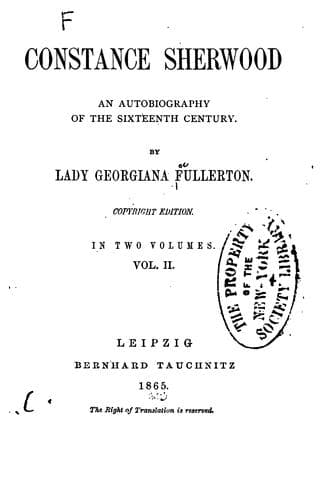
Constance Sherwood: An Autobiography of the Sixteenth CenturyFullerton, Georgiana
History
Constance Sherwood: An Autobiography of the Sixteenth Century
Fullerton, Georgiana
Great Britain -- History -- Elizabeth, 1558-1603 -- Fiction
"In this way, coz," quoth Polly: "she doth often ask the ladies round
her chamber, 'If they love to think of marriage?' and the wise ones do
conceal well their liking thereunto, knowing the queen's judgment in
the matter. But pretty, simple Madge Arundell, not knowing so deeply
as her fellows, was asked one day hereof, and said, 'She had thought
much about marriage, if her father did consent to the man she loved.'
'You seem honest, i' fait said the queen; 'I will sue for you your
father.' At which the dam was well pleased; and when father, Sir
Robert Arundell, came court, the queen questioned him his daughter's
marriage, and pressed him to give consent if the match were discreet.
Sir Robert, much astonished, said, 'He never had heard his daughter
had liking to any man; but he would give his free consent to what was
most pleasing to her highness's will and consent.' Then I will do the
rest,' saith the queen. Poor Madge was called in, and told by the
queen that her father had given his free consent. 'Then,' replied the
simple one, 'I shall be happy, an' it please your grace.' 'So thou
shalt; but not to be a fool and marry,' said the queen. 'I have his
consent given to me, and I vow thou shalt never get it in thy
possession. So go-to about thy business. I see thou art a bold one to
own thy foolishness so readily.'"
"Ah me!" cried Kate, "I be glad not to be a maid to her majesty; for I
would not know how to answer her grace if she should ask me a
like question; for if it be bold to say one hath a reasonable desire
to be married, I must needs be bold then, for I would not for two
thousand pounds break Mr. Lacy's heart; and he saith he will die if I
do not marry him. But, Polly, thou wouldst never be at a loss to
answer her majesty."
"No more than Pace her fool," quoth Polly, "who, when she said, as he
entered the room, 'Now we shall hear of our faults,' cried out, 'Where
is the use of speaking of what all the town doth talk of?'"
"The fool should have been whipped," Mistress Ward said.
"For his wisdom, or for his folly, good Mistress Ward?" asked Polly.
"If for wisdom, 'tis hard to beat a man for being wise. If for folly,
to whip a fool for that he doth follow his calling, and as I be the
licensed fool in this house--which I do take to be the highest
exercise of wit in these days, when all is turned upside down--I do
wish you all good-night, and to be no wiser than is good for your
healths, and no more foolish than suffices to lighten the heart;" and
so laughing she ran away, and Kate said in a lamentable voice,
"I would I were foolish, if it lightens the heart."
"Content thee, good Kate," I said; but in so low a voice none did
hear. And she went on,
"Mr. Lacy is gone to Yorkshire for three weeks, which doth make me
more sad than can be thought of."
Public-domain text, read in full here on John Shaqi.
Reviews
Reviews
No reviews yet
Be the first to share your thoughts on this work.
Elsewhere in the archive
Join the Discussion
Join the discussion
Sign in to leave a comment or review.
Sign InorCreate an account