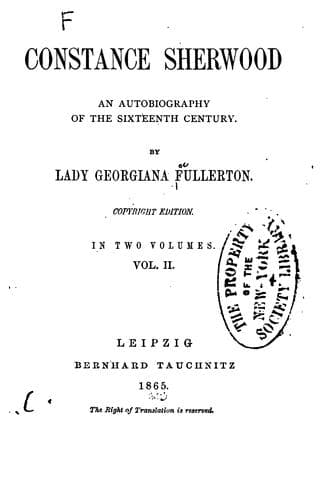
Constance Sherwood: An Autobiography of the Sixteenth Century — John Shaqi
Constance Sherwood: An Autobiography of the Sixteenth CenturyFullerton, Georgiana
History
Constance Sherwood: An Autobiography of the Sixteenth Century
Fullerton, Georgiana
Great Britain -- History -- Elizabeth, 1558-1603 -- Fiction
In this manner we held discourse all the morning, and, like a rude
imp, I questioned the gracious young lady as to her pastimes and her
studies and the tasks she was set to; and from her innocent
conversation I discovered, as children do, without at the time taking
much heed, but yet so as to remember it afterward, what especial care
had been taken by her grandmother--that religious and discreet
lady--to instill into her virtue and piety, and in using her, beside
saying her prayers, to bestow alms with her own hands on prisoners and
poor people; and in particular to apply herself to the cure of
diseases and wounds, wherein she herself had ever excelled. Mistress
Ann, in her childish but withal thoughtful way, chide me that in my
own garden were only seen flowers which pleased the senses by their
bright colors and perfume, and none of the herbs which tend to the
assuagement of pain and healing of wounds; and she made me promise to
grow some against the time of her next visit. As we went through the
kitchen-garden, she plucked some rosemary and lavender and rue, and
many other odoriferous herbs; and sitting down on a bench, she invited
me to her side, and discoursed on their several virtues and properties
with a pretty sort of learning which was marvellous in one of her
years. She showed me which were good for promoting sleep, and which
for cuts and bruises, and of a third she said it eased the heart.
"Nay, Mistress Ann," I cried, "but that must be a heartsease;" at
which she smiled, and answered:
"My grandam says the best medicines for uneasy hearts are the bitter
herb confession and the sweet flower absolution."
"Have you yet made your first communion, Mistress Ann?" I asked in a
low voice, at which question a bright color came into her cheek, and
she replied:
"Not yet; but soon I may. I was confirmed not long ago by the good
Bishop of Durham; and at my grandmother's seat I am to be instructed
by a Catholic priest who lives there."
"Then you do not go to Protestant service?" I said.
"We did," she answered, "for a short time, whilst we stayed at the
Charterhouse; but my grandam has understood that it is not lawful for
Catholics, and she will not be present at it herself, or suffer us any
more to attend it, neither in her own house nor at his grace's."
While we were thus talking, the two little ladies, her sisters, came
from the house, having craved leave from the governess to run out into
the garden. Mistress Mary was a pale delicate child, with soft
loving blue eyes; and Mistress Bess, the youngest, a merry imp, whose
rosy cheeks and dimpling smiles were full of glee and merriment.
"What ugly sober flowers are these, Nan, that thou art playing with?"
she cried, and snatched at the herbs in her sister's lap. "When I
marry my Lord William Howard, I'll wear a posy of roses and
carnations."
"When I am married," said little Mistress Mary, "I will wear nothing
but lilies."
Public-domain text, read in full here on John Shaqi.
Reviews
Reviews
No reviews yet
Be the first to share your thoughts on this work.
Join the Discussion
Join the discussion
Sign in to leave a comment or review.
Sign InorCreate an account