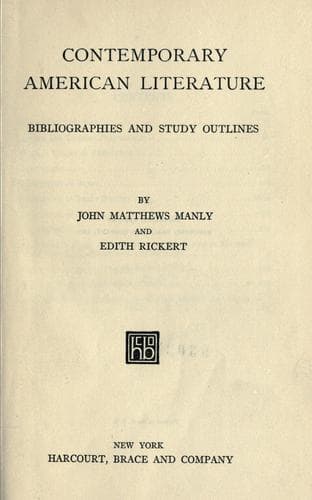
Contemporary American Literature: Bibliographies and Study Outlines — John Shaqi
Contemporary American Literature: Bibliographies and Study OutlinesManly, John Matthews
General
Contemporary American Literature: Bibliographies and Study Outlines
Manly, John Matthews
American literature -- 20th century -- Bio-bibliography; American literature -- Outlines, syllabi, etc.
Am. M. 73 ('11): 71 (portrait), 73.
Bookm. 51 ('20): 568; 54 ('21): 116.
Harp. W. 47 ('03): 411 (portrait), 426.
No. Am. 176 ('03): 739. (Howells.)
Rev. 2 ('20): 461.
+Conrad Potter Aiken+--poet, critic.
Born at Savannah, Georgia, 1889. A.B., Harvard, 1912. Has lived abroad,
in London, Rome, and Windermere.
SUGGESTIONS FOR READING
1. A good introduction to Mr. Aiken's verse is his own explanation of his
theory in _Poetry_, 14 ('19); 152ff. To readers to whom this is not
accessible, the following extracts may furnish some clue as to his aim
and method:
What I had from the outset been somewhat doubtfully hankering for
was some way of getting contrapuntal effects in poetry--the effects
of contrasting and conflicting tones and themes, a kind of
underlying simultaneity in dissimilarity. It seemed to me that by
using a large medium, dividing it into several main parts, and
subdividing these parts into short movements in various veins and
forms, this was rendered possible. I do not wish to press the
musical analogies too closely. I am aware that the word symphony, as
a musical term, has a very definite meaning, and I am aware that it
is only with considerable license that I use the term for such poems
as _Senlin_ or _Forslin_, which have three and five parts
respectively, and do not in any orthodox way develop their themes.
But the effect obtained is, very roughly speaking, that of the
symphony, or symphonic poem. Granted that one has chosen a theme--or
been chosen by a theme!--which will permit rapid changes of tone,
which will not insist on a tone too static, it will be seen that
there is no limit to the variety of effects obtainable: for not only
can one use all the simpler poetic tones...; but, since one is using
them as parts of a larger design, one can also obtain novel effects
by placing them in juxtaposition as consecutive movements....
Public-domain text, read in full here on John Shaqi.
Reviews
Reviews
No reviews yet
Be the first to share your thoughts on this work.
Join the Discussion
Join the discussion
Sign in to leave a comment or review.
Sign InorCreate an account