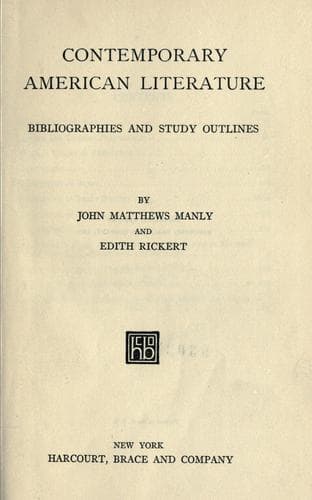
Contemporary American Literature: Bibliographies and Study Outlines — John Shaqi
Contemporary American Literature: Bibliographies and Study OutlinesManly, John Matthews
General
Contemporary American Literature: Bibliographies and Study Outlines
Manly, John Matthews
American literature -- 20th century -- Bio-bibliography; American literature -- Outlines, syllabi, etc.
Acad. 86 ('14): 687.
Bookm. 47 ('18): 394.
Dial, 67 ('19): 302.
Forum, 55 ('16): 675.
Freeman, 1 ('20): 476.
Mentor, 7 ('19): supp. (portrait).
Nation, 109 ('19): 440.
New Repub. 9 ('16): supp. p. 13. (Review of _Spectra_, Bynner.)
Poetry, 7 ('15): 147; 12 ('18): 169; 15 ('20): 281.
See also _Book Review Digest_, 1914, 1920, 1921.
+James Branch Cabell+--novelist, critic.
Born at Richmond, Virginia, 1879, of an old Southern family. A.B.,
William and Mary College, 1898, where he taught French and Greek, 1896-7.
Newspaper work from 1899-1901. Since then he has devoted his time almost
entirely to the study and writing of literature. His study of genealogy
and history has an important bearing upon his creative work.
SUGGESTIONS FOR READING
1. Before reading Mr. Cabell's stories, read his _Beyond Life_, which
explains his theory of romance. He maintains that art should be based on
the dream of life as it should be, not as it is; that enduring
literature is not "reportorial work"; that there is vital falsity in
being true to life because "facts out of relation to the rest of life
become lies," and that art therefore "must become more or less an
allegory."
2. Mr. Cabell's fiction falls into two divisions:
(1) Romances of the middle ages.
(2) Comedies of present-day Virginia.
Both elements are found in _The Cream of the Jest_ (cf. with Du Maurier's
_Peter Ibbetson_). The romances illustrate different aspects of his
theory of chivalry; the modern comedies, his theory of gallantry (cf.
_Beyond Life_).
3. In his romances he has created an imaginary province of France, the
people of which bear names and use idioms drawn from widely diverse and
incongruous sources. His effort to create mediaeval atmosphere by the use
of archaisms does not preclude modern idiom and slang. Through all this
work, elaborate pretense of non-existent sources of the tales and
frequent allusions to fictitious authors are a part of the method. After
reading some of these stories, consider the following criticism from the
_London Times_ quoted by Mr. Cabell himself at the end of _Beyond Life_:
"It requires a nicer touch than Mr. Cabell's, to reproduce the atmosphere
of the Middle Ages ... the artifice is more apparent than the art...."
4. An interesting study is to isolate the authors for whom Mr. Cabell
expresses particular admiration and those for whom he expresses contempt
in _Beyond Life_ and to deduce from his attitudes his peculiar literary
qualities.
5. Mr. Cabell's style is notable for the elaboration of its rhythm, its
careful avoidance of _cliches_, its preference for rare, archaic words
and its allusiveness. Consider it from the point of view of sincerity,
simplicity, clarity, and charm. Does it intensify or dull your interest
in what he has to say? Study, for example, the following exposition of
his theory of art:
Public-domain text, read in full here on John Shaqi.
Reviews
Reviews
No reviews yet
Be the first to share your thoughts on this work.
Join the Discussion
Join the discussion
Sign in to leave a comment or review.
Sign InorCreate an account