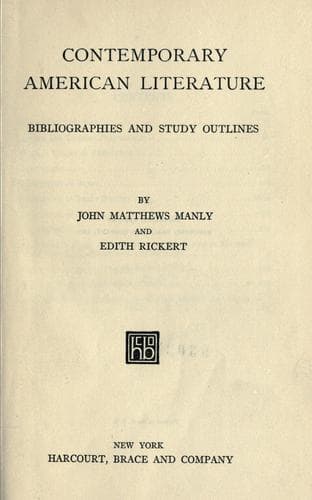
Contemporary American Literature: Bibliographies and Study Outlines — John Shaqi
Contemporary American Literature: Bibliographies and Study OutlinesManly, John Matthews
General
Contemporary American Literature: Bibliographies and Study Outlines
Manly, John Matthews
American literature -- 20th century -- Bio-bibliography; American literature -- Outlines, syllabi, etc.
Born at San Francisco, 1875. At the age of ten, he was taken to New
England where eight generations of his forefathers had lived. In 1892, he
spent a few months at Dartmouth College but disliking college routine,
decided to earn his living, and became a millhand in Lawrence,
Massachusetts. In 1897, two years after he had married, he entered
Harvard and studied there for two years; but he finally gave up the idea
of a degree and turned to various kinds of work, teaching, shoe-making,
and newspaper work. From 1900-11, he was farming at Derry, New Hampshire,
but with little success. At the same time, he was writing and offering
for publication poems which were invariably refused. He likewise taught
English at Derry, 1906-11, and psychology at Plymouth, 1911-2.
In 1912, he sold his farm and with his wife and four children went to
England. He offered a collection of poems to an English publisher and
went to live in the little country town of Beaconsfield. The poems were
published and their merits were quickly recognized. In 1914, Mr. Frost
rented a small place at Ledbury, Gloucestershire, near the English poets,
Lascelles Abercrombie, and W.W. Gibson. With the publication of _North of
Boston_ his reputation as a poet was established.
In 1915, Mr. Frost returned to America and went to live near Franconia,
New Hampshire. From 1916 to 1919 he taught English at Amherst College.
But he found that college life was disturbing to his creative energy, and
in 1920 he bought land in Vermont and again became a farmer. In 1921,
the University of Michigan, in recognition of his talents, offered him a
salary to live in Ann Arbor without teaching. This position he accepted,
but it is reported that he intends to return to farming to secure the
leisure necessary for his work.
SUGGESTIONS FOR READING
1. Make a list of subjects that you have not found treated elsewhere in
poetry. Test the truth of the treatment by your own experience and decide
whether Mr. Frost has converted these commonplace experiences into a new
field of poetry.
2. Read in succession the poems concerning New England life and decide
whether they seem more authentic and more valuable than the others. If
so, why?
3. Is Mr. Frost's realism photographic? Consider in this connection his
own statement: "There are two types of realist--the one who offers a good
deal of dirt with his potato to show that it is a real one; and the one
who is satisfied with the potato brushed clean.... To me the thing that
art does for life is to strip it to form."
In view of the last sentence it is interesting to consider the kinds of
details that Mr. Frost chooses for presentation and those that he omits.
4. Read several of the long poems to discover his relative strength in
narrative and in dramatic presentation.
5. Examine the vocabulary for naturalness, colloquialism, and
extraordinary occasional fitness of words.
Public-domain text, read in full here on John Shaqi.
Reviews
Reviews
No reviews yet
Be the first to share your thoughts on this work.
Join the Discussion
Join the discussion
Sign in to leave a comment or review.
Sign InorCreate an account