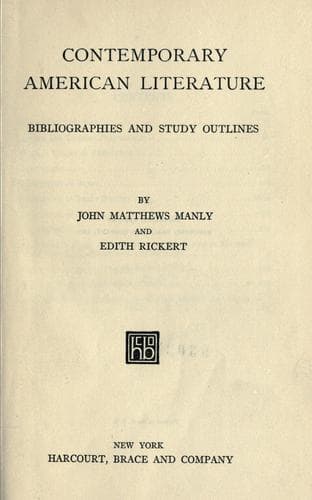
Contemporary American Literature: Bibliographies and Study OutlinesManly, John Matthews
General
Contemporary American Literature: Bibliographies and Study Outlines
Manly, John Matthews
American literature -- 20th century -- Bio-bibliography; American literature -- Outlines, syllabi, etc.
His work is very uneven; but the following books are regarded as among
his best:
The Call of the Wild. 1903.
The Sea-Wolf. 1904.
Martin Eden. 1909. (Autobiographical.)
John Barleycorn. 1913. (Autobiographical.)
For an account of his life and work, see _The Book of Jack London_, by
Charmian London, 1921 (cf. _Freeman_, 4 ['22]: 407). For reviews, cf. the
_Book Review Digest_, especially 1903-7, 1911, 1915.
+Robert Morss Lovett+--man of letters.
Born at Boston, 1870. A.B., Harvard, 1892. Taught English at Harvard,
1892-3; at Chicago, since 1893; professor since 1909. Editor of _The
Dial_, 1919. On the staff of _The New Republic_, 1921--.
BIBLIOGRAPHY
Richard Gresham. 1904. (Novel.)
A Winged Victory. 1907. (Novel.)
Cowards. 1917. (Play, published in _Drama_, 7.)
STUDIES AND REVIEWS
Drama, 7 ('17): 325.
+Amy Lowell+--poet, critic.
Born at Brookline, Massachusetts, 1874. Sister of President Lowell of
Harvard, and of Percival Lowell, the astronomer. Distantly related to
James Russell Lowell. Educated at private schools. Traveled extensively
in Europe as a child. Her visits to Egypt, Greece, and Turkey influenced
her development. In 1902, she decided to become a poet and spent eight
years studying, without publishing a poem. Her first poem appeared in the
_Atlantic_, 1910.
She is a collector of Keats manuscripts and says that the poet who
influenced her most profoundly was Keats. She has also made special study
of Chinese poetry.
SUGGESTIONS FOR READING
1. As Miss Lowell is the principal exponent of the theories of imagism
and free verse in this country, careful reading of some of her critical
papers leads to a better understanding of her work. Especially valuable
are her studies of Paul Fort in her volume entitled _Six French Poets_,
of "H.D." and John Gould Fletcher in her _Tendencies in Modern American
Poetry_, the prefaces to different volumes of her poems and to the
anthologies published under the title _Some Imagist Poets_ (1915, 1916),
and her articles in the _Dial_, 64 ('18): 51 ff., and in Poetry, 3 ('13):
213 ff.
2. In judging her work, consider separately her poems in regular metrical
form and those in free verse. Decide which method is better suited to her
type of imagination.
3. To what extent does her inspiration come from cultural
sources--travel, literature, art, music?
4. Consider especially her presentation of "images." How far do these
seem to be derived from direct experience? Test them by your own
experience. What principles seem to determine her choice of details?
Which sense impressions--sight, sound, taste, smell, touch--does she most
frequently and successfully suggest? Note instances where her figures of
speech sharpen the imagery and others where they seem to distort it. In
what ways is the influence of Keats perceptible in her work?
5. It is worth while to make special study of the historical imagery of
the poems in _Can Grande's Castle_.
Public-domain text, read in full here on John Shaqi.
Reviews
Reviews
No reviews yet
Be the first to share your thoughts on this work.
Elsewhere in the archive
Join the Discussion
Join the discussion
Sign in to leave a comment or review.
Sign InorCreate an account