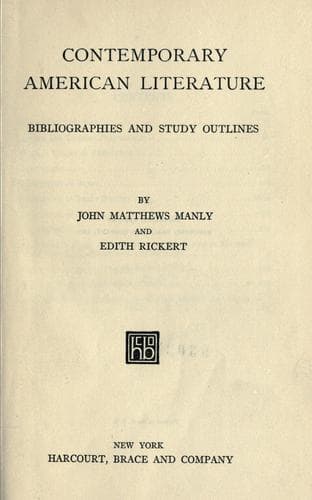
Contemporary American Literature: Bibliographies and Study OutlinesManly, John Matthews
General
Contemporary American Literature: Bibliographies and Study Outlines
Manly, John Matthews
American literature -- 20th century -- Bio-bibliography; American literature -- Outlines, syllabi, etc.
6. If you are familiar with the impressionistic method of painting, work
out an analogy between it and Miss Lowell's word pictures.
7. Study separately her varieties of free verse and polyphonic prose (cf.
her study of Paul Fort and the preface to _Can Grande's Castle_). Choose
several poems in which you think the free verse form is especially
adapted to the content and draw conclusions as to the problems of
development of this kind of verse or of its possible influence upon
regular metrical forms.
8. Use the following poem by Miss Lowell as a basis for judging her work:
FRAGMENT
What is poetry? Is it a mosaic
Of colored stones which curiously are wrought
Into a pattern? Rather glass that's taught
By patient labor any hue to take
And glowing with a sumptuous splendor, make
Beauty a thing of awe; where sunbeams caught,
Transmuted fall in sheafs of rainbows fraught
With storied meaning for religion's sake.
9. In summing up Miss Lowell's achievement, consider the different phases
of it that appear in her volumes taken in chronological order, noting the
successive influences under which she has come. In what qualities does
she stand out strikingly from other contemporary poets? Do you expect
different and more important work from her in the future?
BIBLIOGRAPHY
A Dome of Many-Colored Glass. 1912.
Sword Blades and Poppy Seed. 1914.
Six French Poets. 1915.
Men, Women and Ghosts. 1916.
Tendencies in Modern American Poetry. 1917.
Can Grande's Castle. 1918.
Pictures of the Floating World. 1919.
Legends; Tales of Peoples. 1921.
Fir-Flower Tablets. Poems Translated from the Chinese. 1921. (With
Florence Ayscough.)
STUDIES AND REVIEWS
Boynton.
Hunt, R. and Snow, R.H. Amy Lowell. 1921.
Untermeyer.
Bookm. 47 ('18): 255. (Phelps.)
Chapbook, 1-2, May, 1920: 8.
Dial, 61 ('16): 528; 65 ('18): 346; 67 ('19): 331
Egoist, 1 ('14): 422; 2 ('15): 81, 109; 3 ('16): 9.
Freeman, 4 ('21): 18.
Ind. 87 ('16): 306 (portrait); 88 ('16):533 (portrait); 93 ('18): 294.
Lit. Digest, 52 ('16): 971; 63 ('19): Nov. 29, p. 31 (portraits);
72 ('22): 38.
Lond. Mer., 3 ('21): 441.
New Repub. 6 ('16): 178.
No. Am. 207 ('18): 257, 736.
Poetry, 6 ('15): 32; 9 ('17): 207; 10 ('17): 149; 13 ('18): 97;
15 ('20): 332.
Sewanee R. 28 ('20): 37.
Spec. 125 ('20): 744.
Touchstone, 2 ('18): 416; 7 ('20): 219.
+George Barr McCutcheon+ (1866)--novelist.
The creator of Graustark. For bibliography, see _Who's Who in America_.
+Percy (Wallace) Mackaye+--dramatist, poet.
Born in New York City, 1875, son of Steele Mackaye, dramatist and
manager. A.B., Harvard, 1897. Traveled in Europe, 1898-1900, studying at
the University of Leipzig, 1899-1900. Taught in private school in New
York, 1900-04. Joined the colony at Cornish, New Hampshire, 1904. Since
then has been engaged chiefly in dramatic work.
BIBLIOGRAPHY
Public-domain text, read in full here on John Shaqi.
Reviews
Reviews
No reviews yet
Be the first to share your thoughts on this work.
Elsewhere in the archive
Join the Discussion
Join the discussion
Sign in to leave a comment or review.
Sign InorCreate an account