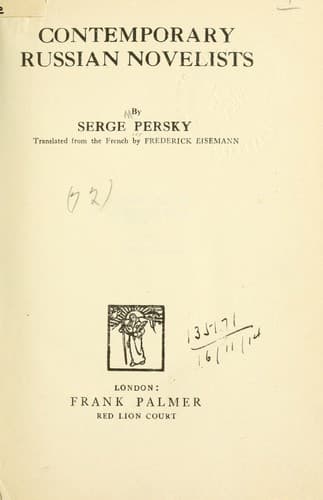
Novelists, Russian; Russian fiction -- History and criticism
Andreyev tells us that on the day of judgment the alienists are
divided as to the insanity of Kerzhenzev. The story ends at this
place. But the principal interest of the story does not lie in this
or that solution of the problem, which is not mysterious, for the
doctor is doubtlessly abnormal, and it is only as to the degree of
insanity that there can be any question. The main interest lies in
another direction, in the subtle analysis of this special mental
condition, which is done with consummate art.
This story had the honor of occupying an entire meeting of the
psychiatrists attached to the Academy of Medicine of St. Petersburg.
According to the report of Dr. Ivanov, the assembly was almost
unanimous in declaring the murderer insane. Another psychiatrist,
who thought he saw proofs of an abnormal mentality in all the
stories of Andreyev, pronounced the same verdict against Dr.
Kerzhenzev, in a meeting of doctors.
* * * * *
"All of priest Vassily Fiveyisky's life was weighed down by a cruel
and enigmatic fatality,"--it is thus that the story, "The Life of a
Pope," opens. "As if struck by an unknown malediction, he had from
his youth been made to carry a heavy burden of sorrows, sickness and
misfortunes; he was solitary among men as a planet is among planets;
a peculiar and malevolent atmosphere surrounded him. Son of an
obscure, patient, and submissive village priest, he also was patient
and submissive, and he was a long time in recognizing the
particular rancour of destiny. He fell rapidly and arose slowly.
Twig by twig he restored his nest. Having become a priest, the
husband of a good woman, the father of a son and a daughter, he
thought that all was going well with him, that all was solidly
established, and that he would remain thus forever. And he blessed
God."
But fate was always on the watch for him. It had showed him
happiness only to take it away again. After seven years of
prosperity, his little son is drowned one summer's day in the river.
Death and nameless misfortunes again invade the home of Vassily. One
does not live there any more, one prowls around gropingly in a
mournful stupor. From morning till evening, his wife comes and goes,
silent and indifferent to everything, as if she were looking for
some one or something.
In losing his son, poor Vassily has also lost his wife, his helpmate
and friend, for the unfortunate woman takes to drink. The faith of
the priest holds in this terrible trial. But his misery increases
immeasurably. The vice of his wife, his own sick weakness, excite
the meanness of the people. Insults have to be borne in silence,
tears hidden. At home, the priest's wife has no rest. She has the
idea that she can have another son who will take the place of the
dead one and be a balm to her broken heart. In her alcoholic desire,
a prey to savage fury, she demands that her husband gratify her
desire.
"Give him to me, Vassily! Give him back to me, I tell you...."
Public-domain text, read in full here on John Shaqi.
Reviews
Reviews
No reviews yet
Be the first to share your thoughts on this work.
Elsewhere in the archive
Join the Discussion
Join the discussion
Sign in to leave a comment or review.
Sign InorCreate an account