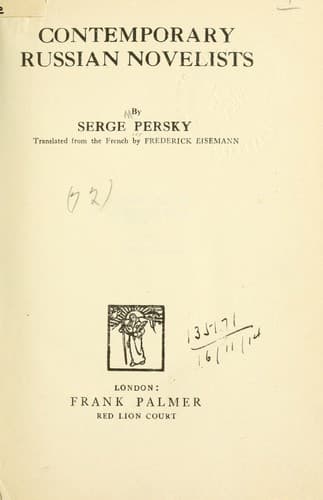
Novelists, Russian; Russian fiction -- History and criticism
At last her desire is realized: a son is born to her; but the child,
conceived in madness, is born half-witted. The mother takes to drink
again, and the despair of Vassily increases. One day the unfortunate
woman hangs herself. The pope comes in, however, in time to save
her; but now another noose has tightened itself about the priest's
heart. One question oppresses him:
"Why these sufferings? If God exists, and if God is love, how is
such misery possible?"
Vassily's faith trembles. He decides to leave his cassock, to fly,
to put his idiot son out to board and to start life over again. This
resolution relieves him. His wife breathes easier. It seems to him
that she also can begin a new life. But fate does not loosen its
reins.
One day, on coming back from the harvest, he finds his house burned.
His wife, in a drunken stupor, had probably set fire to it. She is
dying of her burns. Vassily can only sigh. This new misfortune does
not put an end to the priest, but rather inspires him. His old faith
comes back, he sees in this supreme test a predestination. He kneels
down and cries:
"I believe! I believe! I believe!"
From that time on he devotes himself entirely to prayer and
macerations. He lives in perpetual ecstasy. The people around him
understand nothing of this change and are astounded. Every one of
them is waiting for something unusual. And their waiting is not in
vain. One day, when he is delivering the funeral oration of a
workingman, who has been suddenly killed, Vassily abruptly
interrupts the ceremony, approaches the corpse, which has begun to
decay, and addresses it thus three times:
"I tell you: arise!"
But the dead man does not move. Then the priest looks at this inert
and deformed corpse. He notices the fetid odor that arises from it,
the odor of the slow but sure decomposition, and he has a sort of
sudden revelation. The scepticism which, for a long time, has been
brooding in his heart suddenly is transformed into absolute
negation, and addressing himself to Him in whom he had believed,
Vassily cries out:
"Thou wishest to deceive me? Then why did I believe? Why hast Thou
kept me in servitude, in captivity, all of my life? No free thought!
No feeling! No hope! All with Thee! All for Thee! Thee alone! Well,
appear! I am waiting! I am waiting!... Ah! Thou dost not want to?
Very well...."
He does not finish. In a burst of savage madness he rushes forth
from the now empty church. He rushes straight ahead and finally
falls in the middle of the road. Death has put an end to his
miseries.
Public-domain text, read in full here on John Shaqi.
Reviews
Reviews
No reviews yet
Be the first to share your thoughts on this work.
Elsewhere in the archive
Join the Discussion
Join the discussion
Sign in to leave a comment or review.
Sign InorCreate an account