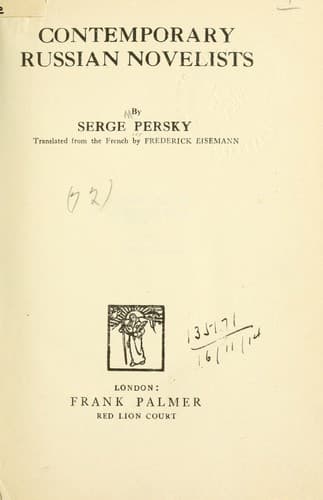
Novelists, Russian; Russian fiction -- History and criticism
Crushed by the same blind destiny which annihilated the powerful
personality of Father Ignatius, the piteous and tearful hero of "The
Marseillaise" moves us even more than does the old priest. The poor
fellow cannot grasp the reason for the ferocity of stupid fate,
which unrelentingly preys upon him. Arrested by mistake as a
revolutionist and condemned to deportation, he becomes an object of
derision to his comrades. However, gradually, he finds the strength
to share the severe privations of his companions who have sacrificed
themselves to their ideal of justice and liberty. And, on his
death-bed, he is elated by all that he has endured; he dreams of
liberty, which, up to this time, had been indifferent to him, and
asks them to sing the Marseillaise over his grave.
"He died, and we sang the Marseillaise. Our young and powerful
voices thundered forth this majestic song of liberty, accompanied by
the noise of the ocean which carried on the crests of its waves
towards 'dear France,' pale terror and blood-red hope.
"It became our standard forever, the picture of this nonentity with
the hare's body and the man's heart.
"On your knees to the hero, friends and comrades!
"We sang. The guns, with their creaking locks, were pointed
menacingly at us; the steel points of the bayonets were pointed at
our hearts. The song resounded louder and louder, with increasing
joy. Held in the friendly hands of the 'strugglers,' the black
coffin slowly sank into the earth.
"We sang the Marseillaise!"
* * * * *
The two main characters of "The Gulf," a student and a school-girl,
are walking and discussing rather deep things, such as immortality
and the beauty of pure and noble love. They feel some sadness in
speaking about these things, but love appears more and more luminous
to them. It rises before their eyes, as large as the world, bursting
forth like the sun and marvelously beautiful, and they know that
there is nothing so powerful as love.
"You could die for the woman you loved?" asked Zinochka.
"Of course," replies Nemovetsky unhesitatingly, in a frank and
sincere voice, "and you?"
"I too!" She remains pensive a moment. "To die for the one you love,
that is a great happiness! Would that that were to be my destiny!"
Gradually night falls. Nemovetsky and his companion lose their way
in the woods; they finally arrive in a clearing, where three
filthy-looking men are seated about an empty bottle. These
intoxicated men, whose wicked eyes light up with a brutal envy of
enjoyment and love of destruction, try to quarrel with Nemovetsky,
and one of them ends by striking him full in the face with his fist.
Zinochka runs away. His heart full of terror, Nemovetsky can hear
the shrieks of his friend, whom the vagabonds have caught. Then a
feeling of emptiness comes over him, and he loses consciousness. Two
of the men throw him into a ravine.
Public-domain text, read in full here on John Shaqi.
Reviews
Reviews
No reviews yet
Be the first to share your thoughts on this work.
Elsewhere in the archive
Join the Discussion
Join the discussion
Sign in to leave a comment or review.
Sign InorCreate an account