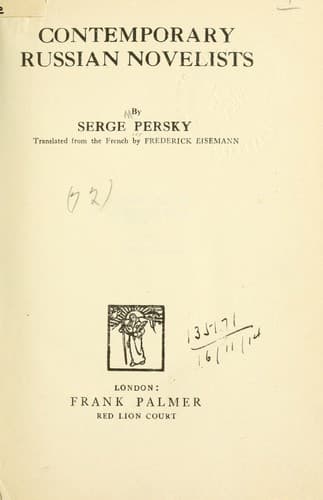
Novelists, Russian; Russian fiction -- History and criticism
The play opens with a scene between Anathema, the incarnation of
Satan, and "He who guards the gates," behind which is the mystery of
eternity. Anathema entreats the Guardian to give him access. But it
is in vain that Anathema flatters and insults him; finally, Anathema
declares that he will choose from among mankind a poor Jew, named
David Leiser, will enrich him and, in order to prove the absolute
nonsense of life, will make this man a living protestation against
the work of Him who knows all. Disguised as the lawyer Nullius,
Anathema comes down to earth and gives millions to David. The
latter, the best of men, distributes his riches among the poor. But
the beggars become more and more numerous, and soon David finds that
he is as poor as he was before the visit of Anathema.
In the meantime, the crowd of paupers, always increasing, ask more
money from David; they demand miracles from this man, whose goodness
has made him a saint, a superman, in their eyes. They bring him
corpses and ask him to resuscitate them. David flees; the crowd
follows and stones him to death. But, through his love for his
fellow-men, David has acquired immortality, as "He who guards the
gates" tells Anathema, when, in the last act, the evil archangel,
beaten, returns to lie on the threshold of the inconceivable
mysterious.
This admirable play, born of a philosophical conception which
relates it to Goethe's "Faust," has been received with particular
interest. Andreyev, in writing it, has come very near to solving the
question of the meaning of life, and its justification. And, to the
person who ponders a while over this work, it will appear that it is
not Anathema who entreats "Him who guards the gates" to reveal the
mystery, but it is Andreyev himself, who, carried away by the force
of his genius, has thrown himself, as if at an invincible wall,
against this pitiless guardian, the guardian of the solution of the
enigma of life.
While "Anathema" is an abstract character, whose form resembles more
an algebraic formula than a living process of human relations,
another of Andreyev's plays, "The Love of the Student," written a
short time before "Anathema," gives us a little picture of customs,
alert and painted with the touch of a master.
Gloukortzev, a young student, falls in love with a young girl whom
her mother forces to become a prostitute. Gloukortzev, young and
inexperienced, has not the slightest suspicion, till the young girl
herself reveals to him the horrible truth. And, perhaps for the
first time in his life, the gulf of necessity, toward which fate
drives men, opens before him. He sees with horror that he cannot
come to the rescue of the girl he loves, because he is poor himself.
He cannot even buy her some food, when she tells him that she has
eaten nothing since the night before. Placed before the absolute
bare reality of life, Gloukortzev does not know what to do, and his
comrades, good and upright fellows like himself, have not the means
to help him.
Public-domain text, read in full here on John Shaqi.
Reviews
Reviews
No reviews yet
Be the first to share your thoughts on this work.
Elsewhere in the archive
Join the Discussion
Join the discussion
Sign in to leave a comment or review.
Sign InorCreate an account