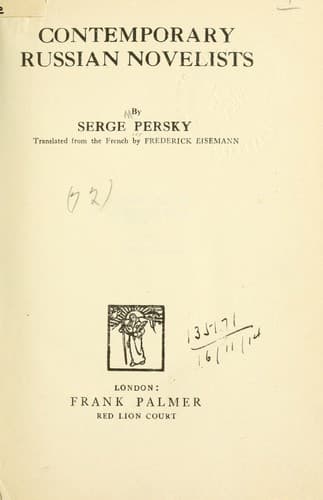
Novelists, Russian; Russian fiction -- History and criticism
Several very successful scenes, in which the author blends the
tragic with the comic, deserve, in this brief analysis, special
attention. In the first act, there is a students' picnic at which
Olga and Gloukortzev, still full of happiness, are present. The
spectator is drawn by personal sympathy to the student Onoufry, a
good fellow, always drunk, who makes fun of others and himself. We
see him again in the second act, when Gloukortzev finds out about
Olga's life. The poignant scene between the poor girl and her lover
is heightened and softened by the arrival of the students, to whom
Gloukortzev tells his sorrow. The last two acts take place in Olga's
home. The mother brings her daughter a rich "client." And, in the
next room, Gloukortzev suffers terribly, because he knows that his
beloved is still leading an infamous life. In the same room, in the
fourth act, we are present at an orgy, during which the student
quarrels with an officer who has come to spend the night with Olga.
But Onoufry, interfering in time, prevents an affray the issue of
which would probably have been fatal. When the curtain falls,
Gloukortzev, intoxicated, is weeping; at his side is Olga, also
weeping, while Onoufry and the officer are singing: "The days of our
lives are as short as the life of a wave."
This drama, as well as most of Andreyev's plays, has been produced
with great success in Russia and also in Europe.
VII
DMITRY MEREZHKOVSKY
Unlike Gorky, Andreyev, and Tchekoff, Merezhkovsky was brought up in
the midst of comfort and elegance; he received a correct and careful
education; fate was solicitous for him, in that it allowed him to
develop that spirit of objective observation and calm meditation
which permits a man to look down on the spectacle of life, and
indulge in philosophical speculations very often divorced from
reality.
The son of an official of the imperial court, Merezhkovsky was born
in St. Petersburg in 1865. In this city he received his entire
education, and here he gained the degree of bachelor of letters in
1886.
He began his literary career with some poems which won for him a
certain renown. In 1888, he published his first collection, and then
a second in 1892, "The Symbols." At the same time, he published
several translations from Greek and Latin authors.
As he was a friend of the unfortunate Nadson, and a pupil of the
humanitarian Pleshcheyev, Merezhkovsky wrote at first under the
influence of the liberal ideas of his early masters. His verses,
always harmonious, and a little affected, soon belied this tendency
and very frankly revealed his preferences. In the first collection
of his poems, vibrant with generous ideas, he proclaimed that he
wanted, above all, "the joy of life," and that a poet should not
have any other cult than that of beauty.
Public-domain text, read in full here on John Shaqi.
Reviews
Reviews
No reviews yet
Be the first to share your thoughts on this work.
Elsewhere in the archive
Join the Discussion
Join the discussion
Sign in to leave a comment or review.
Sign InorCreate an account