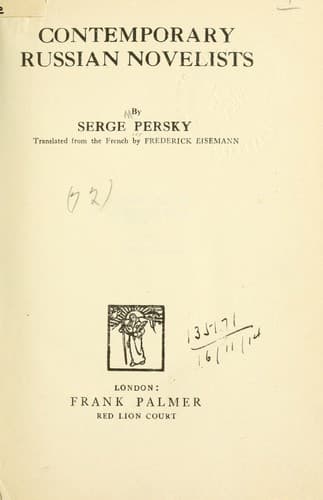
Novelists, Russian; Russian fiction -- History and criticism
Besides his novels Merezhkovsky has published several essays, on
Pushkin, Maykov, Korolenko, Calderon, the French neo-romanticists,
Ibsen and others.... The most important of all are: "The Causes of
the Decadence of Modern Russian Literature" and "Tolstoy and
Dostoyevsky." He reveals here a fine and penetrating power of
observation, which, however, is often obscured because of his
obsession by Nietzschean ideas. Moreover, he does not hide his
antipathy to the people whose literary tastes and ideas differ from
his. From this characteristic comes strange exaggerations and a
somewhat limited appreciation of men and events. An example of
this, for instance, is the impression that he gives in his study of
the causes of the decadence of modern Russian literature, the
subject of which imposes upon the author the double task of
looking up the causes of this decadence and also proving that it
exists. He has not succeeded. In fact, it appears that this idea of
decadence exists only in the minds of the author and of a small
circle of writers who have the same ideas about the mission of
literature. Merezhkovsky is absolutely right in all that he says
about the fact that Russian writers live solitary, deprived of that
precious excitation which is felt when one is in contact with
original and different temperaments; but if you add to this, as he
has done, the statement that Russia does not possess a literature
worthy of the name, you go too far. Without being a great scholar,
it is easy to perceive that our contemporary Russian authors are
legitimate sons of Turgenev, Dostoyevsky and Tolstoy, and grandsons
of Gogol, who himself is closely related to Pushkin. A democratic
and humanitarian realism--widely separated from the Nietzscheism of
Merezhkovsky--strongly characterizes the Russian lineage.
In his book on Tolstoy and Dostoyevsky he spends a long time in
differentiating between the artistic intuition of these two great
masters, who are, according to him, the most profound expression of
the popular and higher element of Russian culture.
What strikes him first in Tolstoy is the insistence with which he
describes "animal man." In a kind of "leitmotiv" Merezhkovsky has
shown us the Tolstoyan characters individualized by very particular
corporal signs. "Tolstoy," he says, "has, to the very highest
degree, the gift of clairvoyance of the flesh; even when dead, the
flesh has a tongue." He is the subtle painter of all sensations and
he is a master in this domain. But his art diminishes singularly,
and even disappears when he tries to analyze the soul within the
flesh. Dostoyevsky, on the other hand, triumphs in his dialogue; one
sees his characters because one shares all their sadness, their
passions, their intelligence, and their sensibility. Dostoyevsky is
the painter of the depths of the human soul, which he portrays with
almost supernatural acuteness. And, as Tolstoy is "the seer of the
flesh," so is Dostoyevsky "the seer of the soul."
Public-domain text, read in full here on John Shaqi.
Reviews
Reviews
No reviews yet
Be the first to share your thoughts on this work.
Elsewhere in the archive
Join the Discussion
Join the discussion
Sign in to leave a comment or review.
Sign InorCreate an account