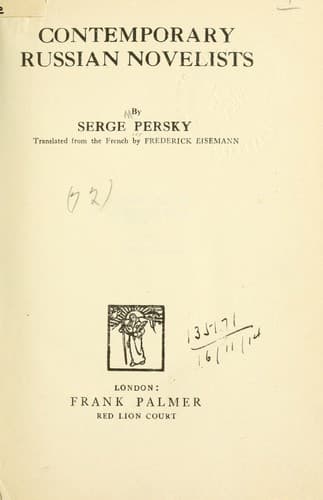
Novelists, Russian; Russian fiction -- History and criticism
Having established this difference in principle, Merezhkovsky, by
constant deduction, concludes, in consonance with his favorite idea,
that Tolstoy personifies "the pagan spirit" at its height, while
Dostoyevsky represents "the Christian spirit." There is a great deal
of fine drawn reasoning in all of this, some very original ideas,
but a great many paradoxes. Even the very personality of Tolstoy,
the analysis of which occupies a large part of the book, is
belittled in the hands of Merezhkovsky. Instead of a noble
character, one sees a very vain person, preoccupied only with
himself. It is in this simple way that Merezhkovsky explains the
moral evolution which led Tolstoy to make those long and sad studies
of a kind of life compatible with the true good of humanity, and
forced him to them by "the anguish of the black mystery of death"
which, having got possession of the author of "Anna Karenina" in his
sixtieth year, in the midst of a life of prosperity, made him hate
his fortune and his comfort, which formerly had been so dear to him.
In the refusal of Tolstoy to "bow to the great authorities of the
literary world, such as AEschylus, Dante, and Shakespeare," a refusal
which is only the logical consequence of his ideas on the principle
and purpose of art, Merezhkovsky can only see a lack of general
culture. Finally, the sort of life he led toward the end of his days
came only "from the desire to know and taste the pleasure of
simplicity in all its subtleties." "The admirable Epicurus," says
Merezhkovsky, "that joyous sage, who, in the very center of Athens,
cultivated with his own hands a tiny garden, and taught men not to
believe in any human or divine chimeras, but to be contented with
the simple happiness that can be given by a single sunbeam, a
flower, a sup of water from an earthen cup, or the summer time,
would recognize in Tolstoy his faithful disciple, the only one,
perhaps, who survives in this barbaric silence, where American
comfort, a mixture of effeminacy and indigence, has made one forget
the real purpose of life...."
In writing these lines, Merezhkovsky must have forgotten that
Tolstoy, in proclaiming his ideas on religion and humanity, prepared
himself, not for Epicurean pleasures, but for seclusion in one of
the terrible dungeons of a Russian monastery (now in disuse) under
the persecutions of a temporal and secular authority, and it was not
his fault that, by a sort of miracle, he escaped this fate.
Dostoyevsky's life is the exact opposite of Tolstoy's. The story of
Dostoyevsky's terrible existence is probably known. Born in an
alms-house, he never ceased to suffer, and to love.... It is hard to
think of two people more absolutely different than Tolstoy and
Dostoyevsky. But Merezhkovsky loves violent contrasts; in the sharp
difference between these two writers, he sees the permanent union of
two controlling ideas of the Russian Renaissance and the imminence
of a final sympathy, symbolic of a concluding harmony.
Public-domain text, read in full here on John Shaqi.
Reviews
Reviews
No reviews yet
Be the first to share your thoughts on this work.
Elsewhere in the archive
Join the Discussion
Join the discussion
Sign in to leave a comment or review.
Sign InorCreate an account