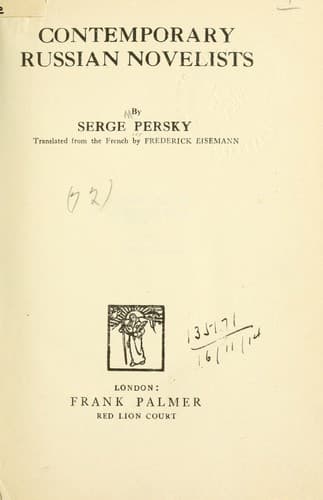
Novelists, Russian; Russian fiction -- History and criticism
This naive and touching letter moves the princess. At the grave of
her unhappy lover, she recalls the words of an old friend of her
father's: "Perhaps he was an abnormal man or a maniac....
Perhaps,--who knows?--your life was illumined by a love of which
women often dream, a kind of love that one does not see nowadays."
* * * * *
One can judge by these summaries how little Kuprin "pads" his
stories. Most of them are reduced to a commonplace anecdote, which
the author is careful not to ornament in the least. He respects
truth to such a degree that he offers it to his readers in its
disconcerting bareness. He would think that he was failing in his
duty as an observer if he disguised it by any literary mechanism.
His work, stripped of all general ideas and of all subjective
aspects, is of a rather curious impersonality. Nothing ever betrays
his intimate thoughts or feelings. And it is in this respect that
he differs so much from most of the writers of to-day, who give
themselves up completely to their attractive heroes and vituperate
their odious people. Kuprin's objective tendencies are best shown in
his story called "Peaceful Life."
A retired official, Nassedkine, who has been enriched by the
gratuities which he has exacted from those who have had to do
business with him, has made it his duty to play censor in his little
town. He makes use of a very discreet and edifying method: to all of
the citizens whose honor is in danger, he sends one or more
anonymous letters telling them of the "extent of their misfortune."
Nassedkine has just finished writing two laconic notes, one of which
is to a young woman whom he tells to visit one of her friends on a
certain day, when, he assures her, her husband is always to be found
there. At this moment the church bells ring, and Nassedkine, who is
religious, goes to vespers. On entering, he notices a fashionable
lady, all dressed in black, in a dark corner of the church.
Nassedkine, more than any one else, knows the heart-rending story of
this woman. She had recently, against her will, married an
excessively rich wood merchant who was almost forty years older than
she. One day, when she thought that her husband had gone off on
business, he returned unexpectedly and found her in the arms of one
of his employees. He had been warned that same morning, by an
anonymous letter, that his wife was deceiving him.
"Beside himself with rage, the merchant threw his employee out of
the house, and then satiated his brutal jealousy on his wife. He
struck her with his big, hobnailed boots; then he called his
coachman and valet, made her undress completely, and had each of
them in turn lash her beautiful body until, covered with blood, she
fainted away.
"And as the priest at the altar was reciting: 'Lord, I offer Thee
the tears of a woman who has sinned,' Nassedkine repeated this
phrase with satisfaction. Then he left the church in order to post
the two letters he had just written."
Public-domain text, read in full here on John Shaqi.
Reviews
Reviews
No reviews yet
Be the first to share your thoughts on this work.
Elsewhere in the archive
Join the Discussion
Join the discussion
Sign in to leave a comment or review.
Sign InorCreate an account