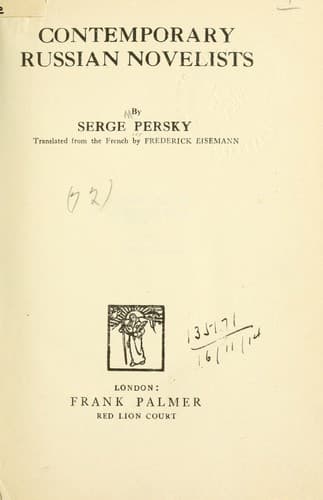
Novelists, Russian; Russian fiction -- History and criticism
This characteristic dryness does not come, as one is liable to
think, from ill-disguised insensibility. Kuprin's soul, on the
contrary, is of such exquisitely fine texture that all human
emotions vibrate there. The few times when he has expressed himself
are enough to convince the reader. He has often pitied women with a
discreet, fraternal compassion. He has also devoted many pages to
the sufferings of animals, be it the story of circus horses hurt by
the rolling of the ship, or the story of a kitten mutilated by
wolves. Only a few words are needed to make us tender and to bring
tears to our eyes. And it is with the eyes of a poet or a child that
he has viewed nature.
* * * * *
No one ever studies a Russian author without finally asking himself
what the author's influence was on the political manifestations of
society. The answer here is not hard to find: Kuprin, observer,
artist, and painter of life, has had no influence. If we except one
story, "The Toast," in which he shows his deep affection for the
oppressed classes, nothing in his work betrays even slightly his
opinions on this subject. Always, the thought of Kuprin deserts the
social struggle to fly into more vast and serene surroundings than
the theatre of wars and revolutions. And he is doubtless ready to
exalt above this terrible struggle, the one thing that he judges
eternal, the love of woman.
"There have been kingdoms and kings," he says in his beautiful
novel, "Sulamite," "and the only trace that is left of them is the
wind in the desert. There have been long and pitiless wars, at the
end of which the names of the leaders sparkled like stars: time has
effaced all memory of them.
"But the love of a poor girl of the vineyards and a great king[17]
will never be effaced and will always live in the minds of men,
because love is divinely beautiful, because every woman who loves is
a queen, because love is stronger than death."
[17] Refers to Solomon.
IX
WRITERS IN VOGUE
As we have already noted in the first chapter of this book, Russian
literature from 1830 to 1905 is distinctly different from European
literature: it is, above all, a literature of action and social
propagandas which puts the popular cause in the place of prominence.
Public-domain text, read in full here on John Shaqi.
Reviews
Reviews
No reviews yet
Be the first to share your thoughts on this work.
Elsewhere in the archive
Join the Discussion
Join the discussion
Sign in to leave a comment or review.
Sign InorCreate an account