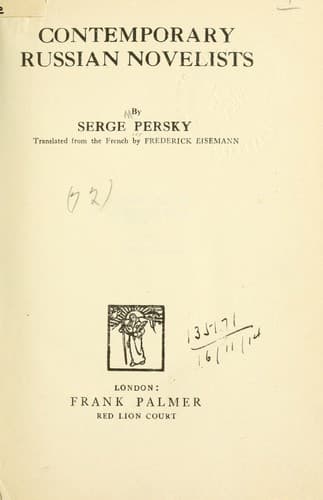
Novelists, Russian; Russian fiction -- History and criticism
This cause has been abandoned by several writers during the last
few years. From 1905 to 1910, an evolution, accelerated by the
most audacious hopes and the most lively beliefs, has transformed
the story and the novel, and has brought to the front certain
authors who, up to this time, had scarcely been known. It seems
as if suddenly the ancient tradition of Russian literature had
been broken. Contrary to the rule of their predecessors, whose
thoughts were on justice and liberty, and whose works breathe
forth a wholesome quality, a large number of the present writers
have been gradually attracted by metaphysical questions, which
fill their works with a veritable chaos of morbid conceptions and
disenchantment. Some express with acuteness man's unconquerable
fear of life or death; others treat of the divine or satanic
principles in man; still others study, with a sickly passion, the
problems of the flesh in all of its manifestations.[18]
[18] Happily, this literary crisis seems to have been ephemeral.
Since the beginning of 1910, according to a Russian critic, "the
salubrity of the atmosphere" has been accomplished. The "cursed
questions" are less prominent in recent works, and it seems that
the crisis which desolated Russian literature for several years
has come to an end, and that the writers are going back to the old
traditions of Russian literature.
Among the latter, Michael Artzybashev is a writer of great breadth,
whose erotic tendencies have spoiled some of his best traits. His
novel, "Sanine," which recently caused so much talk, pretends to
paint the youth of to-day in Russia. If we believed the author, we
should conclude that the above-mentioned youth consisted of
hysterical people in whom chastity was the least of virtues.
The heroes of his novel are two representatives of the revolutionary
youth, Sanine and Yuri Svagorich. Both of them have deserted "the
cause," Sanine, through lassitude, and Yuri, who has met nothing but
a despairing indifference among those whom he wanted to save from
"the oppression of the shadows," through scorn. Yuri, "a man of the
past," is an "intellectual" entirely impregnated with generous
altruism, haunted by social and political preoccupations. But he is
also a "failure" who falls from one deception into another, because
he is thoroughly powerless to combat life.
On the other hand, his friend, Vladimir Sanine, "the man of the
future," is, without a doubt, capable of living. None is freer than
he from all social and political preoccupations, and none is more
than he resolved to obey only his lucid egotism, or the suggestions
of his instincts.
Public-domain text, read in full here on John Shaqi.
Reviews
Reviews
No reviews yet
Be the first to share your thoughts on this work.
Elsewhere in the archive
Join the Discussion
Join the discussion
Sign in to leave a comment or review.
Sign InorCreate an account