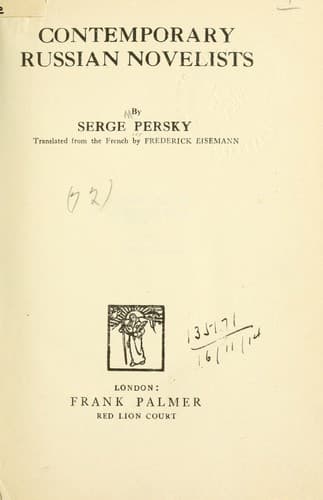
Novelists, Russian; Russian fiction -- History and criticism
In all of Korolenko's works we distinctly feel the living breath
that inspires the artist, and the ardor of a fervent ideal. His god
is man; his ideal, humanity; his "leitmotiv," the poetry of human
suffering. This intimate connection with all that is human is to
be found in his psychological analysis as well as in his
descriptions of natural phenomena. Both God and nature are in turn
spiritualized and humanized. Korolenko looks at life from a human
standpoint; the world which he describes is made up wholly of men
and exists for them only. He has a very clear philosophy, and a
conscience aware of the duties it has to perform. If he has not
opened up hitherto unknown paths, nor made new roads, he has
himself nevertheless passed through terrible experiences; he has
been a prey to profound sorrows and doubts, and in spite of all, he
has kept his love for the people intact, and deeply pities their
ignorance and abasement. His work constantly recalls to our minds
the theory that the cultivated classes are in debt to the people
for the education which they have received at the people's expense.
This is the great moral principle which governs the conscience of
the Russian "intellectuals." It is in this sense then, that
Korolenko may be said to continue the literature of 1870, and to be
the successor of Zlatovratsky and Uspensky. But he has reincarnated
this past in new forms, which naturally result from the activity of
his far-sighted, powerful intelligence. We do not find in his work
either the nervousness, often sickly, which pervades the works of
Uspensky, or the optimism of Zlatovratsky, which often excessively
idealizes the life of the Russian peasant, who is the principal
hero of all his works. Korolenko, because he puts a high value on
human personality, perfectly appreciates the terrible struggle that
man has to make in order to secure his rights. A desire for justice
on the one hand, and a defence of man's dignity on the other, form
the very essence of the talent of this author, and it is with these
feelings that he observes the people on whom injustice weighs most
heavily and who have merely remnants of human dignity left in their
make-up,--for in general, these people are not those whom fate has
overcome. Most of them lead a hard and gloomy life beset with
misfortunes. Many of them are vagabonds, escaped convicts,
drunkards, murderers, who are bowed down with misery, and have no
wish except to escape the mortal dangers of the Siberian forests
and marshes. On opening any of Korolenko's books we find ourselves,
to use his own words, in "bad company." He does not flatter his
heroes, he does not make gentlemen of them; they are not even men,
but rather human rubbish.
Public-domain text, read in full here on John Shaqi.
Reviews
Reviews
No reviews yet
Be the first to share your thoughts on this work.
Join the Discussion
Join the discussion
Sign in to leave a comment or review.
Sign InorCreate an account