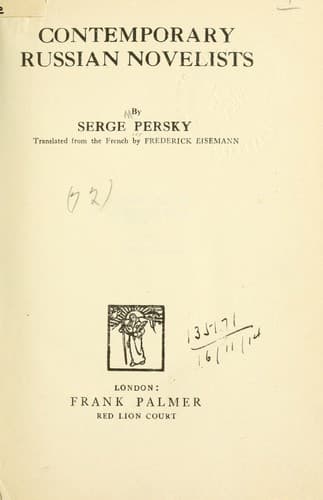
Novelists, Russian; Russian fiction -- History and criticism
The observations that Korolenko was able to make were many and
diverse. By going all over Russia he gathered inexhaustible riches,
in the form of anecdotes and actual experiences. This can be easily
realized when we consider the sumptuous variety of his descriptions.
Where do we not go, and whom do we not meet in his books? First, we
are in a peaceful little town of the southwest, then in the thick
woods of Poliyessye, in the snow-covered and frozen Siberian
forests, or in the valleys of Sakhaline, inhabited by half-breed
Russians and escaped convicts, not to mention the innumerable
sectarians who fill the Siberian prisons. And Korolenko never
repeats. Not even a detail occurs more than once. Each of his works
is a little world in itself. The author, moreover, unlike other
writers, is never satisfied with pale sketches; each character is
shown in full relief, each picture is absolutely finished. This
wholeness, this finish which does not hurt the harmony of the
proportions, is a precious quality, very rare in our time.
* * * * *
The "Sketches of a Siberian Tourist," published in 1896, in which
bandits of various odd types tell thrilling tales of nocturnal
attacks and other adventures, is a kind of artistic novel. The
postillion is the most original character in the book. Huge of
stature, audacious and clever, he exercises a mysterious influence
over the brigands, whom he inspires with a superstitious terror.
Most of them, thinking him invulnerable, do not dare attack the
travelers whom he is driving.
That same year another work of Korolenko's appeared, called: "In Bad
Company,"--a sort of autobiography which added to his renown. The
story, poetically simple, is laid in a provincial town. The hero is
a little, seven-year-old boy called Volodya. He is the son of the
local judge. The mother has been dead for a long time, and the
father, in his sorrow, more or less loses track of his children, who
roam about unwatched.
The little town has its historic legends; it boasts of the ruins of
a castle, which in times gone by was inhabited by rich Polish
counts, whose descendants, having become poor, have long since left
their manorial home. The castle has served as a refuge for a nomadic
population. Expelled by the count's agent, this little band has
taken up its abode in a dilapidated chapel in the crypts of a
cemetery.
The chief of this barefoot brigade is called Tibertius Droba. He has
two children: Vanek, a large, dark-haired lad, whom one sees
wandering about the village with a sullen look on his face, and
Maroussya, a small and thin child, who is gradually fading away in
the darkness of her cellar-like home.
Public-domain text, read in full here on John Shaqi.
Reviews
Reviews
No reviews yet
Be the first to share your thoughts on this work.
Join the Discussion
Join the discussion
Sign in to leave a comment or review.
Sign InorCreate an account