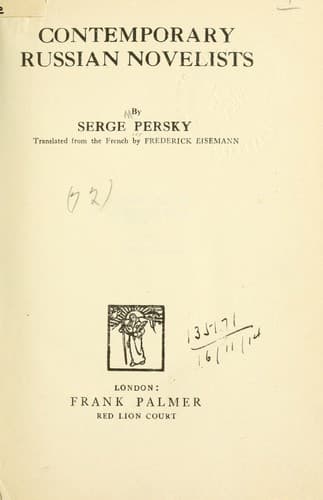
Novelists, Russian; Russian fiction -- History and criticism
Andrey has not yet rid himself of his rustic unsociability; however,
he is beginning to become civilized, and is receiving city culture.
He tries to free himself from his misery, from his degradation. He
beats his wife when he is drunk, but, at the same time, he gets
angry at a friend when he beats his mistress.... According to his
own confession he reads many useless things, nevertheless he can
become interested in a serious work. If he drinks to excess, it is
to "drive away the thoughts" that torment him. He wants to analyze
every question and find out what is at the bottom of it. He is the
spiritual brother of Natasha, Chekanhov, and Tanya.
The sequel to this story is "The Straight Road." This time we are
transported into the world of factory workers, a world lamentable
for its misery, despair, and crime. Andrey Ivanovich's wife,
Alexandra Mikhailovna, being without resources after the death of
her husband, with a little daughter in arms, enters a book-binding
establishment, belonging to a man named Semidalov. But the foreman,
a vicious and evil-minded man, reigns as despot. It is he who gives
out the work. The young girls who listen to his advances are sure
of being shown partiality; the others are badly treated. As
Alexandra wants to live honestly, her work in the shop is made very
hard. Her best friend, Tanya, who inadvertently spilled oil on some
paper and could not pay for the damage, had to give herself to the
foreman. Finally Tanya despairs and ends by drowning herself.
Alexandra is saved, thanks to a "loveless" marriage with the
locksmith, Lestmann. She accepts this union so that she will not
have to starve and can remain "straight." Thus, the "straight road"
which Alexandra wanted to follow has forced her finally to sell
herself, to marry a man whom she does not love.
* * * * *
Each page of Veressayev's work exists merely to throw light on this
or that social question, considered from a well defined point of
view. The secret of his success rests mostly in the frank, sincere
manner in which he has approached certain problems. At the same
time, all of his work breathes forth a deep and tender love for
those who suffer. In reality, there is not a single book by
Veressayev which might not be a confession; all that he writes he
has already experienced himself, and his work vibrates with a
delicate and personal emotion. It is only necessary to read "The
Memoirs of a Physician," which is almost an autobiography, in order
to perceive the moral relationship that exists between Veressayev
and the heroes of his stories.
Public-domain text, read in full here on John Shaqi.
Reviews
Reviews
No reviews yet
Be the first to share your thoughts on this work.
Elsewhere in the archive
Join the Discussion
Join the discussion
Sign in to leave a comment or review.
Sign InorCreate an account