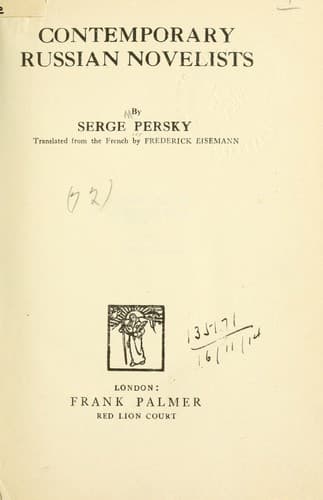
Novelists, Russian; Russian fiction -- History and criticism
It would be most interesting to read a sequel to the three famous
novels of Veressayev--"Astray," "The Contagion," and "At the
Turning"--in which he would give us the psychology of his former
heroes under present conditions. To-day, the people are not
"astray"; the field is big enough for every one to find the place
that best suits his ideas, tastes, and temperament. Dr. Chekanhov,
if he were living now, instead of being maltreated by the people,
would certainly be their well beloved champion, and perhaps
represent them in the Duma; the timid Tokarev, in spite of his
aversion to the ideas of the revolutionists, could find a place in
the liberal party of the Reforming Democrats, or at least among the
Octobrists; the unfortunate Varenka would not be worn out by her
work as school-mistress, for she would be supported by the peasants.
The peasants themselves are not the miserable and resigned creatures
of Veressayev's earlier stories. Certainly, liberty is not yet a
legal thing in Russia, and the Duma is still an unstable
institution, but the end of absolutism is near, for a great event
has taken place in the empire of the Tsar, namely, this awakening of
the feeling of human dignity, and the spirit of revolt among the
lower strata of the Russian people, which in the past, by its
unconsciousness, formed the granite pedestal of autocracy. The
struggle is terrible, but confidence in final victory redoubles the
energy of the strugglers. A certain Russian was right when he said:
"Formerly, life was formidable, but now it is both formidable and
gay."
In reading the works of Veressayev, Tchekoff, and other painters of
modern Russian society, it is easy to note that not one of them
anticipated this sudden change of scenery on the Russian political
stage, a change which, however, was being prepared in the souls of
the peasants. But let us not reproach them! Russia will always
remain an enigma.
There is a very old story about the son of the peasant Ilya
Murometz. After remaining lazily resting in his "isba" for thirty
years, he suddenly arose, and began to walk with such fury that the
earth trembled. How could these writers conceive the time when this
lazy giant would make up his mind to walk? It is enough to have the
assurance that now, no matter what happens, since he _has_ arisen,
he will not lie down again.
V
MAXIM GORKY
Public-domain text, read in full here on John Shaqi.
Reviews
Reviews
No reviews yet
Be the first to share your thoughts on this work.
Elsewhere in the archive
Join the Discussion
Join the discussion
Sign in to leave a comment or review.
Sign InorCreate an account