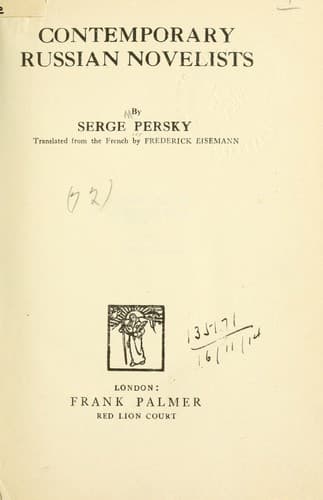
Novelists, Russian; Russian fiction -- History and criticism
Maxim Gorky is the most original and, after Tolstoy, the most
talented of modern Russian writers. He was born in 1868 or 1869--he
does not know exactly when himself--in a dyer's back shop at Nizhny
Novgorod. His mother, Barbara Kashirina, was the daughter of the
aforementioned dyer; and his father, Maxim Pyeshkov, was an
upholsterer. The child was christened Alexis. His real name, then,
is Alexis Pyeshkov, and Maxim Gorky[6] is only his pseudonym. When
he was four, he lost his father, and three years later, his mother.
He was then taken by his grandfather, who had been a soldier under
Nicholas I, a hard, authoritative, pitiless old man, before whom all
trembled. And it was under his rude tutelage that the child first
began to read. When he was nine, he was sent to work for a
shoemaker, an evil sort of man who maltreated him.
[6] In Russian, Gorky means bitterness.
"One day," Gorky tells us, "I was warming some water for him; the
bowl fell, and I burned my hands badly. That evening I ran away, my
grandfather having scolded me severely. I then became a painter's
apprentice."
He did not remain long in this position. From this time on, his
unsatisfied soul was seized with the "wanderlust." First apprenticed
to an engraver, and then as a gardener, he finally became a scullion
on one of the boats that plies up and down the Volga. Here he felt
more at ease.
On board, in the person of the master-cook, named Smoury, he
unexpectedly met a teacher. This cook, who had been a soldier, loved
to read, and he gave the child all the books that he had in an old
trunk. They consisted of the works of Gogol, Dumas' novels, the
"Lives of the Saints," a manual of geography, and some popular
novels. Surely, a queer collection!
Smoury inspired his scullion, then sixteen years of age, "with an
ardent curiosity for the printed word." A "furious" desire to learn
seized the young fellow; he went to Kazan, a university city, in the
hope of "learning gratuitously all sorts of beautiful things." Cruel
deception! They explained to him that "this was not according to the
established order." Discouraged, a few months later, he took a
position with a baker. He who dreamed of the sun and the open air
had to be imprisoned in a filthy and damp cellar. He remained there
for two years, earning two dollars a month, board and lodging
included; the food, however, was putrid, and his lodging consisted
of an attic which he shared with five other men.
"My life in that bakery," he has said, "left a bitter impression.
Those two years were the hardest of my whole life." He has thus
described his recollections in one of his stories:
Public-domain text, read in full here on John Shaqi.
Reviews
Reviews
No reviews yet
Be the first to share your thoughts on this work.
Elsewhere in the archive
Join the Discussion
Join the discussion
Sign in to leave a comment or review.
Sign InorCreate an account