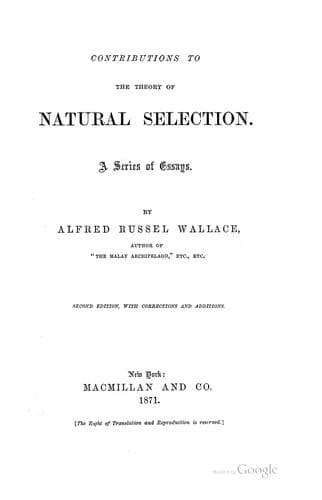
Contributions to the Theory of Natural Selection: A Series of EssaysWallace, Alfred Russel
Science
Contributions to the Theory of Natural Selection: A Series of Essays
Wallace, Alfred Russel
Natural selection
_there_ to the other; but we are by no means to suppose that these
conditions consist in climate alone. It is highly probable that the
existence of enemies, and of competing forms of life, may be the main
determining influences; and it is much to be wished that such a
competent observer as Mr. Walsh would endeavour to ascertain what are
the adverse causes which are most efficient in keeping down the numbers
of each of these contrasted forms.
Dimorphism of this kind in the animal kingdom does not seem to have any
direct relations to the reproductive powers, as Mr. Darwin has shown to
be the case in plants, nor does it appear to be very general. One other
case only is known to me in another family of my eastern Lepidoptera,
the Pieridae; and but few occur in the Lepidoptera of other countries.
The spring and autumn broods of some European species differ very
remarkably; and this must be considered as a phenomenon of an analogous
though not of an identical nature, while the Araschnia prorsa, of
Central Europe, is a striking example of this alternate or seasonal
dimorphism. Among our nocturnal Lepidoptera, I am informed, many
analogous cases occur; and as the whole history of many of these has
been investigated by breeding successive generations from the egg, it is
to be hoped that some of our British Lepidopterists will give us a
connected account of all the abnormal phenomena which they present.
Among the Coleoptera Mr. Pascoe has pointed out the existence of two
forms of the male sex in seven species of the two genera Xenocerus and
Mecocerus belonging to the family Anthribidae, (Proc. Ent. Soc. Lond.,
1862); and no less than six European Water-beetles, of the genus
Dytiscus, have females of two forms, the most common having the elytra
deeply sulcate, the rarer smooth as in the males. The three, and
sometimes four or more, forms under which many Hymenopterous insects
(especially Ants) occur, must be considered as a related phenomenon,
though here each form is specialized to a distinct function in the
economy of the species. Among the higher animals, albinoism and melanism
may, as I have already stated, be considered as analogous facts; and I
met with one case of a bird, a species of Lory (Eos fuscata), clearly
existing under two differently coloured forms, since I obtained both
sexes of each from a single flock, while no intermediate specimens have
yet been found.
Public-domain text, read in full here on John Shaqi.
Reviews
Reviews
No reviews yet
Be the first to share your thoughts on this work.
Elsewhere in the archive
Join the Discussion
Join the discussion
Sign in to leave a comment or review.
Sign InorCreate an account