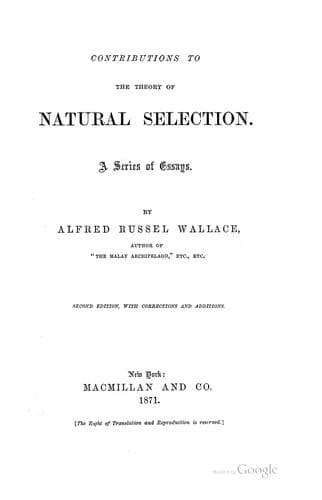
Contributions to the Theory of Natural Selection: A Series of EssaysWallace, Alfred Russel
Science
Contributions to the Theory of Natural Selection: A Series of Essays
Wallace, Alfred Russel
Natural selection
we consider, further, that in four separate islands, in each of which I
resided for several months, the two forms of female were obtained and
only one form of male ever seen, and that about the same time, M.
Montrouzier in Woodlark Island, at the other extremity of New Guinea
(where he resided several years, and must have obtained all the large
Lepidoptera of the island), obtained females closely resembling mine,
which, in despair at finding no appropriate partners for them, he mates
with a widely different species--it becomes, I think, sufficiently
evident this is another case of polymorphism of the same nature as those
already pointed out in P. Pammon and P. Memnon. This species, however,
is not only dimorphic, but trimorphic; for, in the island of Waigiou, I
obtained a third female quite distinct from either of the others, and in
some degree intermediate between the ordinary female and the male. The
specimen is particularly interesting to those who believe, with Mr.
Darwin, that extreme difference of the sexes has been gradually produced
by what he terms sexual selection, since it may be supposed to exhibit
one of the intermediate steps in that process, which has been
accidentally preserved in company with its more favoured rivals, though
its extreme rarity (only one specimen having been seen to many hundreds
of the other form) would indicate that it may soon become extinct.
The only other case of polymorphism in the genus Papilio, at all equal
in interest to those I have now brought forward, occurs in America; and
we have, fortunately, accurate information about it. Papilio Turnus is
common over almost the whole of temperate North America; and the female
resembles the male very closely. A totally different-looking insect both
in form and colour, Papilio Glaucus, inhabits the same region; and
though, down to the time when Boisduval published his "Species General,"
no connexion was supposed to exist between the two species, it is now
well ascertained that P. Glaucus is a second female form of P. Turnus.
In the "Proceedings of the Entomological Society of Philadelphia," Jan.,
1863, Mr. Walsh gives a very interesting account of the distribution of
this species. He tells us that in the New England States and in New York
all the females are yellow, while in Illinois and further south all are
black; in the intermediate region both black and yellow females occur in
varying proportions. Lat. 37 deg. is approximately the southern limit of the
yellow form, and 42 deg. the northern limit of the black form; and, to
render the proof complete, both black and yellow insects have been bred
from a single batch of eggs. He further states that, out of thousands
of specimens, he has never seen or heard of intermediate varieties
between these forms. In this interesting example we see the effects of
latitude in determining the proportions in which the individuals of each
form should exist. The conditions are _here_ favourable to the one form,
Public-domain text, read in full here on John Shaqi.
Reviews
Reviews
No reviews yet
Be the first to share your thoughts on this work.
Elsewhere in the archive
Join the Discussion
Join the discussion
Sign in to leave a comment or review.
Sign InorCreate an account