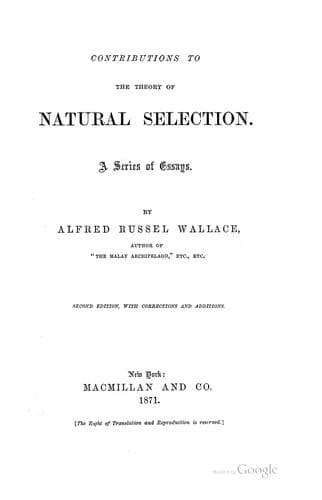
Contributions to the Theory of Natural Selection: A Series of EssaysWallace, Alfred Russel
Science
Contributions to the Theory of Natural Selection: A Series of Essays
Wallace, Alfred Russel
Natural selection
10. The following law may be deduced from these facts:--_Every species
has come into existence coincident both in space and time with a
pre-existing closely allied species._
This law agrees with, explains and illustrates all the facts connected
with the following branches of the subject:--1st. The system of natural
affinities. 2nd. The distribution of animals and plants in space. 3rd.
The same in time, including all the phaenomena of representative groups,
and those which Professor Forbes supposed to manifest polarity. 4th. The
phaenomena of rudimentary organs. We will briefly endeavour to show its
bearing upon each of these.
_The Form of a true system of Classification determined by this Law._
If the law above enunciated be true, it follows that the natural series
of affinities will also represent the order in which the several species
came into existence, each one having had for its immediate antitype a
closely allied species existing at the time of its origin. It is
evidently possible that two or three distinct species may have had a
common antitype, and that each of these may again have become the
antitypes from which other closely allied species were created. The
effect of this would be, that so long as each species has had but one
new species formed on its model, the line of affinities will be simple,
and may be represented by placing the several species in direct
succession in a straight line. But if two or more species have been
independently formed on the plan of a common antitype, then the series
of affinities will be compound, and can only be represented by a forked
or many branched line. Now, all attempts at a Natural classification and
arrangement of organic beings show, that both these plans have obtained
in creation. Sometimes the series of affinities can be well represented
for a space by a direct progression from species to species or from
group to group, but it is generally found impossible so to continue.
There constantly occur two or more modifications of an organ or
modifications of two distinct organs, leading us on to two distinct
series of species, which at length differ so much from each other as to
form distinct genera or families. These are the parallel series or
representative groups of naturalists, and they often occur in different
countries, or are found fossil in different formations. They are said to
have an analogy to each other when they are so far removed from their
common antitype as to differ in many important points of structure,
while they still preserve a family resemblance. We thus see how
difficult it is to determine in every case whether a given relation is
an analogy or an affinity, for it is evident that as we go back along
the parallel or divergent series, towards the common antitype, the
analogy which existed between the two groups becomes an affinity. We are
also made aware of the difficulty of arriving at a true classification,
Public-domain text, read in full here on John Shaqi.
Reviews
Reviews
No reviews yet
Be the first to share your thoughts on this work.
Join the Discussion
Join the discussion
Sign in to leave a comment or review.
Sign InorCreate an account