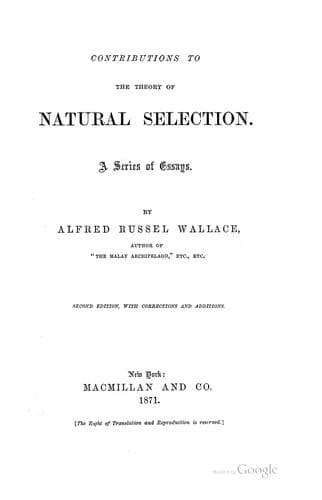
Contributions to the Theory of Natural Selection: A Series of EssaysWallace, Alfred Russel
Science
Contributions to the Theory of Natural Selection: A Series of Essays
Wallace, Alfred Russel
Natural selection
We have, therefore, fourteen species or marked varieties of Papilio,
which so closely resemble species of other groups in their respective
localities, that it is not possible to impute the resemblance to
accident. The first two in the list (Papilio paradoxa and P. Caunus) are
so exactly like Euploea Midamus and E. Rhadamanthus on the wing, that
although they fly very slowly, I was quite unable to distinguish them.
The first is a very interesting case, because the male and female differ
considerably, and each mimics the corresponding sex of the Euploea. A
new species of Papilio which I discovered in New Guinea resembles Danais
sobrina, from the same country, just as Papilio Marcareus resembles
Danais Aglaia in Malacca, and (according to Dr. Horsfield's figure)
still more closely in Java. The Indian Papilio Agestor closely imitates
Danais Tytia, which has quite a different style of colouring from the
preceding; and the extraordinary Papilio Idaeoides from the Philippine
Islands, must, when on the wing, perfectly resemble the Hestia Leuconoe
of the same region, as also does the Papilio Delessertii imitate the
Ideopsis daos from Penang. Now in every one of these cases the Papilios
are very scarce, while the Danaidae which they resemble are exceedingly
abundant--most of them swarming so as to be a positive nuisance to the
collecting entomologist by continually hovering before him when he is in
search of newer and more varied captures. Every garden, every roadside,
the suburbs of every village are full of them, indicating very clearly
that their life is an easy one, and that they are free from persecution
by the foes which keep down the population of less favoured races. This
superabundant population has been shown by Mr. Bates to be a general
characteristic of all American groups and species which are objects of
mimicry; and it is interesting to find his observations confirmed by
examples on the other side of the globe.
Public-domain text, read in full here on John Shaqi.
Reviews
Reviews
No reviews yet
Be the first to share your thoughts on this work.
Elsewhere in the archive
Join the Discussion
Join the discussion
Sign in to leave a comment or review.
Sign InorCreate an account