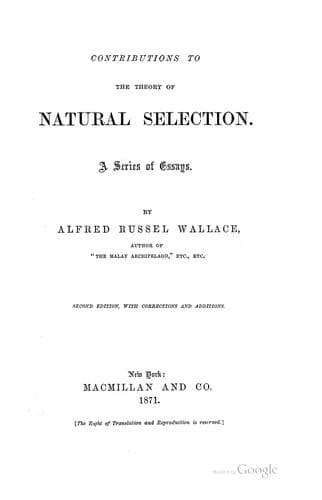
Contributions to the Theory of Natural Selection: A Series of EssaysWallace, Alfred Russel
Science
Contributions to the Theory of Natural Selection: A Series of Essays
Wallace, Alfred Russel
Natural selection
The remarkable genus Drusilla, a group of pale-coloured butterflies,
more or less adorned with ocellate spots, is also the object of mimicry
by three distinct genera (Melanitis, Hyantis, and Papilio). These
insects, like the Danaidae, are abundant in individuals, have a very
weak and slow flight, and do not seek concealment, or appear to have any
means of protection from insectivorous creatures. It is natural to
conclude, therefore, that they have some hidden property which saves
them from attack; and it is easy to see that when any other insects, by
what we call accidental variation, come more or less remotely to
resemble them, the latter will share to some extent in their immunity.
An extraordinary dimorphic form of the female of Papilio Ormenus has
come to resemble the Drusillas sufficiently to be taken for one of that
group at a little distance; and it is curious that I captured one of
these Papilios in the Aru Islands hovering along the ground, and
settling on it occasionally, just as it is the habit of the Drusillas to
do. The resemblance in this case is only general; but this form of
Papilio varies much, and there is therefore material for natural
selection to act upon, so as ultimately to produce a copy as exact as in
the other cases.
The eastern Papilios allied to Polydorus, Coon, and Philoxenus, form a
natural section of the genus resembling, in many respects, the
AEneas-group of South America, which they may be said to represent in the
East. Like them, they are forest insects, have a low and weak flight,
and in their favourite localities are rather abundant in individuals;
and like them, too, they are the objects of mimicry. We may conclude,
therefore, that they possess some hidden means of protection, which
makes it useful to other insects to be mistaken for them.
The Papilios which resemble them belong to a very distinct section of
the genus, in which the sexes differ greatly; and it is those females
only which differ most from the males, and which have already been
alluded to as exhibiting instances of dimorphism, which resemble species
of the other group.
The resemblance of P. Romulus to P. Hector is, in some specimens, very
considerable, and has led to the two species being placed following each
other in the British Museum Catalogues and by Mr. E. Doubleday. I have
shown, however, that P. Romulus is probably a dimorphic form of the
female P. Pammon, and belongs to a distinct section of the genus.
Public-domain text, read in full here on John Shaqi.
Reviews
Reviews
No reviews yet
Be the first to share your thoughts on this work.
Elsewhere in the archive
Join the Discussion
Join the discussion
Sign in to leave a comment or review.
Sign InorCreate an account