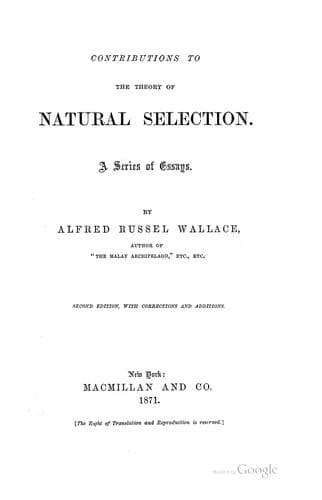
Contributions to the Theory of Natural Selection: A Series of EssaysWallace, Alfred Russel
Science
Contributions to the Theory of Natural Selection: A Series of Essays
Wallace, Alfred Russel
Natural selection
This summary of the more interesting phenomena of variation presented by
the eastern Papilionidae is, I think, sufficient to substantiate my
position, that the Lepidoptera are a group that offer especial
facilities for such inquiries; and it will also show that they have
undergone an amount of special adaptive modification rarely equalled
among the more highly organized animals. And, among the Lepidoptera, the
great and pre-eminently tropical families of Papilionidae and Danaidae
seem to be those in which complicated adaptations to the surrounding
organic and inorganic universe have been most completely developed,
offering in this respect a striking analogy to the equally
extraordinary, though totally different, adaptations which present
themselves in the Orchideae, the only family of plants in which mimicry
of other organisms appears to play any important part, and the only one
in which cases of conspicuous polymorphism occur; for as such we must
class the male, female, and hermaphrodite forms of Catasetum
tridentatum, which differ so greatly in form and structure that they
were long considered to belong to three distinct genera.
_Arrangement and Geographical Distribution of the Malayan Papilionidae_.
_Arrangement._--Although the species of Papilionidae inhabiting the
Malayan region are very numerous, they all belong to three out of the
nine genera into which the family is divided. One of the remaining
genera (Eurycus) is restricted to Australia, and another (Teinopalpus)
to the Himalayan Mountains, while no less than four (Parnassius,
Doritis, Thais, and Sericinus) are confined to Southern Europe and to
the mountain-ranges of the Palaearctic region.
The genera Ornithoptera and Leptocircus are highly characteristic of
Malayan entomology, but are uniform in character and of small extent.
The genus Papilio, on the other hand, presents a great variety of forms,
and is so richly represented in the Malay Islands, that more than
one-fourth of all the known species are found there. It becomes
necessary, therefore, to divide this genus into natural groups before we
can successfully study its geographical distribution.
Owing principally to Dr. Horsfield's observations in Java, we are
acquainted with a considerable number of the larvae of Papilios; and
these furnish good characters for the primary division of the genus into
natural groups. The manner in which the hinder wings are plaited or
folded back at the abdominal margin, the size of the anal valves, the
structure of the antennae, and the form of the wings are also of much
service, as well as the character of the flight and the style of
colouration. Using these characters, I divide the Malayan Papilios into
four sections, and seventeen groups, as follows:--
Genus ORNITHOPTERA.
a. Priamus-group. } Black and Green.
c. Brookeanus-group.}
b. Pompeus-group. Black and yellow.
Genus PAPILIO.
A. Larvae short, thick, with numerous fleshy tubercles;
of a purplish colour.
Public-domain text, read in full here on John Shaqi.
Reviews
Reviews
No reviews yet
Be the first to share your thoughts on this work.
Elsewhere in the archive
Join the Discussion
Join the discussion
Sign in to leave a comment or review.
Sign InorCreate an account