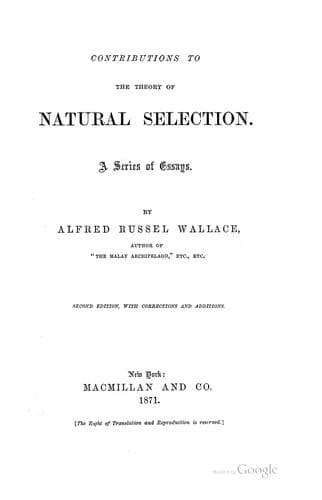
Contributions to the Theory of Natural Selection: A Series of EssaysWallace, Alfred Russel
Science
Contributions to the Theory of Natural Selection: A Series of Essays
Wallace, Alfred Russel
Natural selection
a. Nox-group. Abdominal fold in male very large;
anal valves small, but swollen; antennae moderate;
wings entire, or tailed; includes the Indian
Philoxenus-group.
b. Coon-group. Abdominal fold in male small; anal
valves small, but swollen; antennae moderate;
wings tailed.
c. Polydorus-group. Abdominal fold in male small,
or none; anal valves small or obsolete, hairy;
wings tailed or entire.
B. Larvae with third segment swollen, transversely or
obliquely banded; pupa much bent. Imago with
abdominal margin in male plaited, but not reflexed;
body weak; antennae long; wings much
dilated, often tailed.
d. Ulysses-group.
{Protenor-group (Indian) is
e. Peranthus-group. {somewhat intermediate between
f. Memnon-group. {these, and is nearest
{to the Nox-group.
g. Helenus-group.
h. Erectheus-group.
i. Pammon-group.
k. Demolion-group.
C. Larvae subcylindrical, variously coloured. Imago with
abdominal margin in male plaited, but not reflexed;
body weak; antennae short, with a thick
curved club; wings entire.
l. Erithonius-group. Sexes alike, larva and pupa
something like those of P. Demolion.
m. Paradoxa-group. Sexes different.
n. Dissimilis-group. Sexes alike; larva bright-coloured;
pupa straight, cylindric.
D. Larvae elongate, attenuate behind, and often bifid, with
lateral and oblique pale stripes, green. Imago
with the abdominal margin in male reflexed,
woolly or hairy within; anal valves small, hairy;
antennae short, stout; body stout.
o. Macareus-group. Hind wings entire.
p. Antiphates-group. Hind wings much tailed (swallow-tails).
q. Eurypylus-group. Hind wings elongate or tailed.
Genus LEPTOCIRCUS.
Making, in all, twenty distinct groups of Malayan Papilionidae.
The first section of the genus Papilio (A) comprises insects which,
though differing considerably in structure, having much general
resemblance. They all have a weak, low flight, frequent the most
luxuriant forest-districts, seem to love the shade, and are the objects
of mimicry by other Papilios.
Section B consists of weak-bodied, large-winged insects, with an
irregular wavering flight, and which, when resting on foliage, often
expand the wings, which the species of the other sections rarely or
never do. They are the most conspicuous and striking of eastern
Butterflies.
Section C consists of much weaker and slower-flying insects, often
resembling in their flight, as well as in their colours, species of
Danaidae.
Public-domain text, read in full here on John Shaqi.
Reviews
Reviews
No reviews yet
Be the first to share your thoughts on this work.
Elsewhere in the archive
Join the Discussion
Join the discussion
Sign in to leave a comment or review.
Sign InorCreate an account