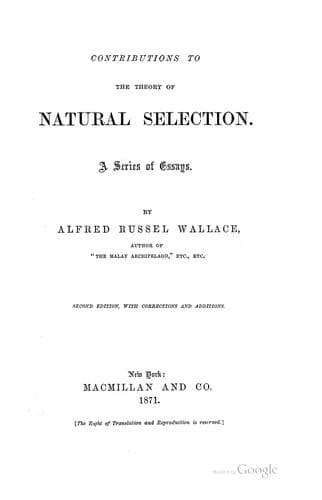
Contributions to the Theory of Natural Selection: A Series of EssaysWallace, Alfred Russel
Science
Contributions to the Theory of Natural Selection: A Series of Essays
Wallace, Alfred Russel
Natural selection
Whatever we may define instinct to be, it is evidently some form of
mental manifestation, and as we can only judge of mind by the analogy of
our own mental functions and by observation of the results of mental
action in other men and in animals, it is incumbent on us, first, to
study and endeavour to comprehend the minds of infants, of savage men,
and of animals not very far removed from ourselves, before we pronounce
positively as to the nature of the mental operations in creatures so
radically different from us as insects. We have not yet even been able
to ascertain what are the senses they possess, or what relation their
powers of seeing, hearing, and feeling have to ours. Their sight may far
exceed ours both in delicacy and in range, and may possibly give them
knowledge of the internal constitution of bodies analogous to that which
we obtain by the spectroscope; and that their visual organs do possess
some powers which ours do not, is indicated by the extraordinary
crystalline rods radiating from the optic ganglion to the facets of the
compound eye, which rods vary in form and thickness in different parts
of their length, and possess distinctive characters in each group of
insects. This complex apparatus, so different from anything in the eyes
of vertebrates, may subserve some function quite inconceivable by us, as
well as that which we know as vision. There is reason to believe that
insects appreciate sounds of extreme delicacy, and it is supposed that
certain minute organs, plentifully supplied with nerves, and situated in
the subcostal vein of the wing in most insects, are the organs of
hearing. But besides these, the Orthoptera (such as grasshoppers, &c.)
have what are supposed to be ears on their fore legs, and Mr. Lowne
believes that the little stalked balls, which are the sole remnants of
the hind wings in flies, are also organs of hearing or of some analogous
sense. In flies, too, the third joint of the antennae contains thousands
of nerve-fibres, which terminate in small open cells, and this Mr. Lowne
believes to be the organ of smell, or of some other, perhaps new, sense.
It is quite evident, therefore, that insects may possess senses which
give them a knowledge of that which we can never perceive, and enable
them to perform acts which to us are incomprehensible. In the midst of
this complete ignorance of their faculties and inner nature, is it wise
for us to judge so boldly of their powers by a comparison with our own?
How can we pretend to fathom the profound mystery of their mental
nature, and decide what, and how much, they can perceive or remember,
reason or reflect! To leap at one bound from our own consciousness to
that of an insect's, is as unreasonable and absurd as if, with a pretty
good knowledge of the multiplication table, we were to go straight to
the study of the calculus of functions, or as if our comparative
anatomists should pass from the study of man's bony structure to that of
Public-domain text, read in full here on John Shaqi.
Reviews
Reviews
No reviews yet
Be the first to share your thoughts on this work.
Elsewhere in the archive
Join the Discussion
Join the discussion
Sign in to leave a comment or review.
Sign InorCreate an account