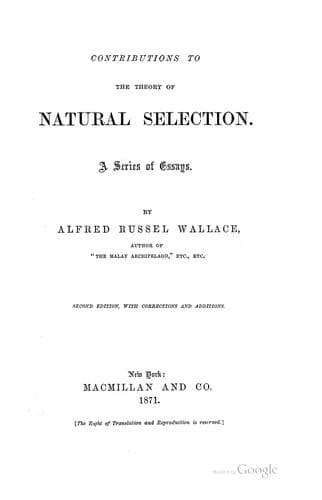
Contributions to the Theory of Natural Selection: A Series of EssaysWallace, Alfred Russel
Science
Contributions to the Theory of Natural Selection: A Series of Essays
Wallace, Alfred Russel
Natural selection
the fish, and, without any knowledge of the numerous intermediate forms,
were to attempt to determine the homologies between these distant types
of vertebrata. In such a case would not error be inevitable, and would
not continued study in the same direction only render the erroneous
conclusions more ingrained and more irremovable.
_Definition of Instinct._
Before going further into this subject, we must determine what we mean
by the term instinct. It has been variously defined as--"disposition
operating without the aid of instruction or experience," "a mental power
totally independent of organization," or "a power enabling an animal to
do that which, in those things man can do, results from a chain of
reasoning, and in things which man cannot do, is not to be explained by
any efforts of the intellectual faculties." We find, too, that the word
instinct is very frequently applied to acts which are evidently the
result either of organization or of habit. The colt or calf is said to
walk instinctively, almost as soon as it is born; but this is solely due
to its organization, which renders walking both possible and pleasurable
to it. So we are said instinctively to hold out our hands to save
ourselves from falling, but this is an acquired habit, which the infant
does not possess. It appears to me that instinct should be defined
as--"the performance by an animal of complex acts, absolutely without
instruction or previously-acquired knowledge." Thus, acts are said to be
performed by birds in building their nests, by bees in constructing
their cells, and by many insects in providing for the future wants of
themselves or their progeny, without ever having seen such acts
performed by others, and without any knowledge of why they perform them
themselves. This is expressed by the very common term "blind instinct."
But we have here a number of assertions of matters of fact, which,
strange to say, have never been proved to be facts at all. They are
thought to be so self-evident that they may be taken for granted. No
one has ever yet obtained the eggs of some bird which builds an
elaborate nest, hatched these eggs by steam or under a quite distinct
parent, placed them afterwards in an extensive aviary or covered garden,
where the situation and the materials of a nest similar to that of the
parent birds may be found, and then seen what kind of nest these birds
would build. If under these rigorous conditions they choose the same
materials, the same situation, and construct the nest in the same way
and as perfectly as their parents did, instinct would be proved in their
case; now it is only assumed, and assumed, as I shall show further on,
without any sufficient reason. So, no one has ever carefully taken the
pupae of a hive of bees out of the comb, removed them from the presence
of other bees, and loosed them in a large conservatory with plenty of
flowers and food, and observed what kind of cells they would construct.
Public-domain text, read in full here on John Shaqi.
Reviews
Reviews
No reviews yet
Be the first to share your thoughts on this work.
Elsewhere in the archive
Join the Discussion
Join the discussion
Sign in to leave a comment or review.
Sign InorCreate an account