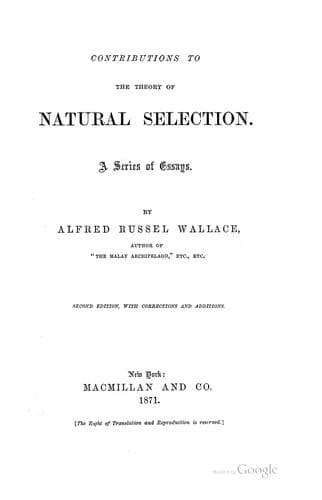
Contributions to the Theory of Natural Selection: A Series of EssaysWallace, Alfred Russel
Science
Contributions to the Theory of Natural Selection: A Series of Essays
Wallace, Alfred Russel
Natural selection
If we now consider the geographical distribution of animals and plants
upon the earth, we shall find all the facts beautifully in accordance
with, and readily explained by, the present hypothesis. A country having
species, genera, and whole families peculiar to it, will be the
necessary result of its having been isolated for a long period,
sufficient for many series of species to have been created on the type
of pre-existing ones, which, as well as many of the earlier-formed
species, have become extinct, and thus made the groups appear isolated.
If in any case the antitype had an extensive range, two or more groups
of species might have been formed, each varying from it in a different
manner, and thus producing several representative or analogous groups.
The Sylviadae of Europe and the Sylvicolidae of North America, the
Heliconidae of South America and the Euploeas of the East, the group of
Trogons inhabiting Asia, and that peculiar to South America, are
examples that may be accounted for in this manner.
Such phaenomena as are exhibited by the Galapagos Islands, which contain
little groups of plants and animals peculiar to themselves, but most
nearly allied to those of South America, have not hitherto received any,
even a conjectural explanation. The Galapagos are a volcanic group of
high antiquity, and have probably never been more closely connected with
the continent than they are at present. They must have been first
peopled, like other newly-formed islands, by the action of winds and
currents, and at a period sufficiently remote to have had the original
species die out, and the modified prototypes only remain. In the same
way we can account for the separate islands having each their peculiar
species, either on the supposition that the same original emigration
peopled the whole of the islands with the same species from which
differently modified prototypes were created, or that the islands were
successively peopled from each other, but that new species have been
created in each on the plan of the pre-existing ones. St. Helena is a
similar case of a very ancient island having obtained an entirely
peculiar, though limited, flora. On the other hand, no example is known
of an island which can be proved geologically to be of very recent
origin (late in the Tertiary, for instance), and yet possesses generic
or family groups, or even many species peculiar to itself.
Public-domain text, read in full here on John Shaqi.
Reviews
Reviews
No reviews yet
Be the first to share your thoughts on this work.
Join the Discussion
Join the discussion
Sign in to leave a comment or review.
Sign InorCreate an account