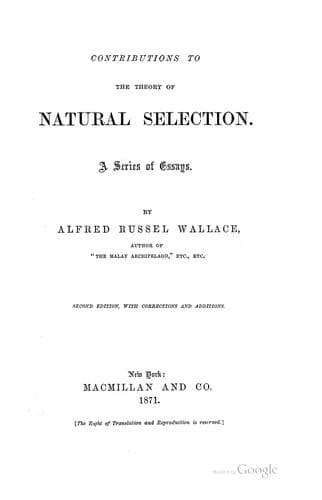
Contributions to the Theory of Natural Selection: A Series of EssaysWallace, Alfred Russel
Science
Contributions to the Theory of Natural Selection: A Series of Essays
Wallace, Alfred Russel
Natural selection
This doctrine is so very general that it may almost be said to be
universally adopted. Men who agree on nothing else, accept this as a
good explanation of the facts. Philosophers and poets, metaphysicians
and divines, naturalists and the general public, not only agree in
believing this to be probable, but even adopt it as a sort of axiom that
is so self-evident as to need no proof, and use it as the very
foundation of their speculations on instinct and reason. A belief so
general, one would think, must rest on indisputable facts, and be a
logical deduction from them. Yet I have come to the conclusion that not
only is it very doubtful, but absolutely erroneous; that it not only
deviates widely from the truth, but is in almost every particular
exactly opposed to it. I believe, in short, that birds do _not_ build
their nests by instinct; that man does _not_ construct his dwelling by
reason; that birds do change and improve when affected by the same
causes that make men do so; and that mankind neither alter nor improve
when they exist under conditions similar to those which are almost
universal among birds.
_Do Men build by Reason or by Imitation?_
Let us first consider the theory of reason, as alone determining the
domestic architecture of the human race. Man, as a reasonable animal, it
is said, continually alters and improves his dwelling. This I entirely
deny. As a rule, he neither alters nor improves, any more than the birds
do. What have the houses of most savage tribes improved from, each as
invariable as the nest of a species of bird? The tents of the Arab are
the same now as they were two or three thousand years ago, and the mud
villages of Egypt can scarcely have improved since the time of the
Pharaohs. The palm-leaf huts and hovels of the various tribes of South
America and the Malay Archipelago, what have they improved from since
those regions were first inhabited? The Patagonian's rude shelter of
leaves, the hollowed bank of the South African Earthmen, we cannot even
conceive to have been ever inferior to what they now are. Even nearer
home, the Irish turf cabin and the Highland stone shelty can hardly have
advanced much during the last two thousand years. Now, no one imputes
this stationary condition of domestic architecture among these savage
tribes to instinct, but to simple imitation from one generation to
another, and the absence of any sufficiently powerful stimulus to
change or improvement. No one imagines that if an infant Arab could be
transferred to Patagonia, or to the Highlands, it would, when it grew
up, astonish its foster-parents by constructing a tent of skins. On the
other hand, it is quite clear that physical conditions, combined with
the degree of civilization arrived at, almost necessitate certain types
of structure. The turf, or stones, or snow--the palm-leaves, bamboo, or
branches, which are the materials of houses in various countries, are
used because nothing else is so readily to be obtained. The Egyptian
Public-domain text, read in full here on John Shaqi.
Reviews
Reviews
No reviews yet
Be the first to share your thoughts on this work.
Elsewhere in the archive
Join the Discussion
Join the discussion
Sign in to leave a comment or review.
Sign InorCreate an account