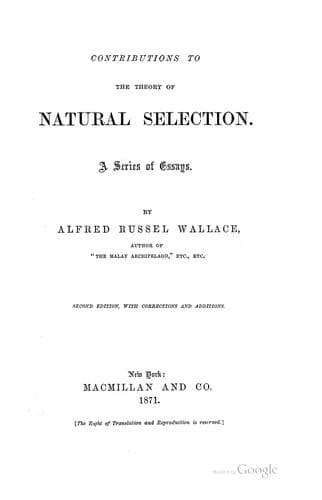
Contributions to the Theory of Natural Selection: A Series of EssaysWallace, Alfred Russel
Science
Contributions to the Theory of Natural Selection: A Series of Essays
Wallace, Alfred Russel
Natural selection
peasant has none of these, not even wood. What, then, can he use but
mud? In tropical forest-countries, the bamboo and the broad palm-leaves
are the natural material for houses, and the form and mode of structure
will be decided in part by the nature of the country, whether hot or
cool, whether swampy or dry, whether rocky or plain, whether frequented
by wild beasts, or whether subject to the attacks of enemies. When once
a particular mode of building has been adopted, and has become confirmed
by habit and by hereditary custom, it will be long retained, even when
its utility has been lost through changed conditions, or through
migration into a very different region. As a general rule, throughout
the whole continent of America, native houses are built directly upon
the ground--strength and security being given by thickening the low
walls and the roof. In almost the whole of the Malay Islands, on the
contrary, the houses are raised on posts, often to a great height, with
an open bamboo floor; and the whole structure is exceedingly slight and
thin. Now, what can be the reason of this remarkable difference between
countries, many parts of which are strikingly similar in physical
conditions, natural productions, and the state of civilization of their
inhabitants? We appear to have some clue to it in the supposed origin
and migrations of their respective populations. The indigenes of
tropical America are believed to have immigrated from the north--from a
country where the winters are severe, and raised houses with open floors
would be hardly habitable. They moved southwards by land along the
mountain ranges and uplands, and in an altered climate continued the
mode of construction of their forefathers, modified only by the new
materials they met with. By minute observations of the Indians of the
Amazon Valley, Mr. Bates arrived at the conclusion that they were
comparatively recent immigrants from a colder climate. He says:--"No one
could live long among the Indians of the Upper Amazon without being
struck with their constitutional dislike to the heat ... Their skin is
hot to the touch, and they perspire little ... They are restless and
discontented in hot, dry weather, but cheerful on cool days, when the
rain is pouring down their naked backs." And, after giving many other
details, he concludes, "How different all this is with the Negro, the
true child of tropical climes! The impression gradually forced itself on
my mind that the Red Indian lives as an immigrant or stranger in these
hot regions, and that his constitution was not originally adapted, and
has not since become perfectly adapted, to the climate."
Public-domain text, read in full here on John Shaqi.
Reviews
Reviews
No reviews yet
Be the first to share your thoughts on this work.
Elsewhere in the archive
Join the Discussion
Join the discussion
Sign in to leave a comment or review.
Sign InorCreate an account