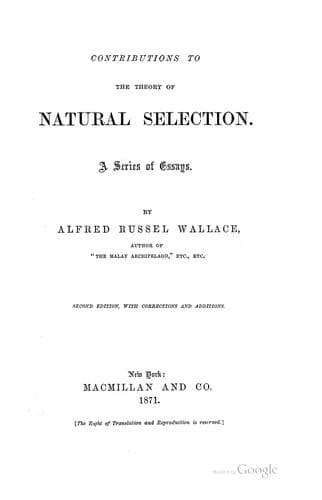
Contributions to the Theory of Natural Selection: A Series of EssaysWallace, Alfred Russel
Science
Contributions to the Theory of Natural Selection: A Series of Essays
Wallace, Alfred Russel
Natural selection
Many terns and sandpipers lay their eggs on the bare sand of the
sea-shore, and no doubt the Duke of Argyll is correct when he says, that
the cause of this habit is not that they are unable to form a nest, but
that, in such situations, any nest would be conspicuous and lead to the
discovery of the eggs. The choice of _place_ is, however, evidently
determined by the habits of the birds, who, in their daily search for
food, are continually roaming over extensive tide-washed flats. Gulls
vary considerably in their mode of nesting, but it is always in
accordance with their structure and habits. The situation is either on a
bare rock or on ledges of sea-cliffs, in marshes or on weedy shores. The
materials are sea-weed, tufts of grass or rushes, or the _debris_ of the
shore, heaped together with as little order and constructive art as
might be expected from the webbed feet and clumsy bill of these birds,
the latter better adapted for seizing fish than for forming a delicate
nest. The long-legged, broad-billed flamingo, who is continually
stalking over muddy flats in search of food, heaps up the mud into a
conical stool, on the top of which it lays its eggs. The bird can thus
sit upon them conveniently, and they are kept dry, out of reach of the
tides.
Now I believe that throughout the whole class of birds the same general
principles will be found to hold good, sometimes distinctly, sometimes
more obscurely apparent, according as the habits of the species are more
marked, or their structure more peculiar. It is true that, among birds
differing but little in structure or habits, we see considerable
diversity in the mode of nesting, but we are now so well assured that
important changes of climate and of surface have occurred within the
period of existing species, that it is by no means difficult to see how
such differences have arisen. Simple habits are known to be hereditary,
and as the area now occupied by each species is different from that of
every other, we may be sure that such changes would act differently upon
each, and would often bring together species which had acquired their
peculiar habits in distinct regions and under different conditions.
_How do Young Birds learn to Build their First Nest?_
Public-domain text, read in full here on John Shaqi.
Reviews
Reviews
No reviews yet
Be the first to share your thoughts on this work.
Elsewhere in the archive
Join the Discussion
Join the discussion
Sign in to leave a comment or review.
Sign InorCreate an account