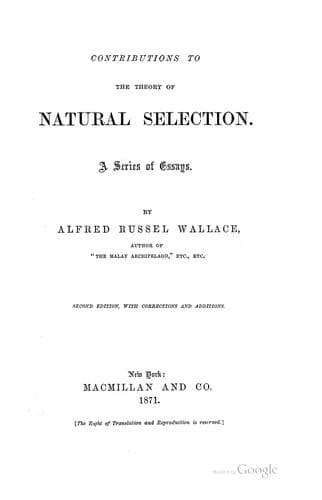
Contributions to the Theory of Natural Selection: A Series of EssaysWallace, Alfred Russel
Science
Contributions to the Theory of Natural Selection: A Series of Essays
Wallace, Alfred Russel
Natural selection
But it is objected, birds do not _learn_ to make their nest as man does
to build, for all birds will make exactly the same nest as the rest of
their species, even if they have never seen one, and it is instinct
alone that can enable them to do this. No doubt this would be instinct
if it were true, and I simply ask for proof of the fact. This point,
although so important to the question at issue, is always assumed
without proof, and even against proof, for what facts there are, are
opposed to it. Birds brought up from the egg in cages do not make the
characteristic nest of their species, even though the proper materials
are supplied them, and often make no nest at all, but rudely heap
together a quantity of materials; and the experiment has never been
fairly tried, of turning out a pair of birds so brought up, into an
enclosure covered with netting, and watching the result of their
untaught attempts at nest-making. With regard to the songs of birds,
however, which is thought to be equally instinctive, the experiment has
been tried, and it is found that young birds never have the song
peculiar to their species if they have not heard it, whereas they
acquire very easily the song of almost any other bird with which they
are associated.
_Do Birds sing by Instinct or by Imitation?_
The Hon. Daines Barrington was of opinion that "notes in birds are no
more innate than language is in man, and depend entirely on the master
under which they are bred, _as far as their organs will enable them to
imitate_ the sounds which they have frequent opportunities of hearing."
He has given an account of his experiments in the "Philosophical
Transactions" for 1773 (Vol. 63); he says: "I have educated nestling
linnets under the three best singing larks--the skylark, woodlark, and
titlark, every one of which, instead of the linnet's song, adhered
entirely to that of their respective instructors. When the note of the
titlark linnet was thoroughly fixed, I hung the bird in a room with two
common linnets for a quarter of a year, which were full in song; the
titlark linnet, however, did not borrow any passage from the linnet's
song, but adhered stedfastly to that of the titlark." He then goes on
to say that birds taken from the nest at two or three weeks old have
already learnt the call-note of their species. To prevent this the birds
must be taken from the nest when a day or two old, and he gives an
account of a goldfinch which he saw at Knighton in Radnorshire, and
which sang exactly like a wren, without any portion of the proper note
of its species. This bird had been taken from the nest at two or three
days old, and had been hung at a window opposite a small garden, where
it had undoubtedly acquired the notes of the wren without having any
opportunity of learning even the call of the goldfinch.
Public-domain text, read in full here on John Shaqi.
Reviews
Reviews
No reviews yet
Be the first to share your thoughts on this work.
Elsewhere in the archive
Join the Discussion
Join the discussion
Sign in to leave a comment or review.
Sign InorCreate an account