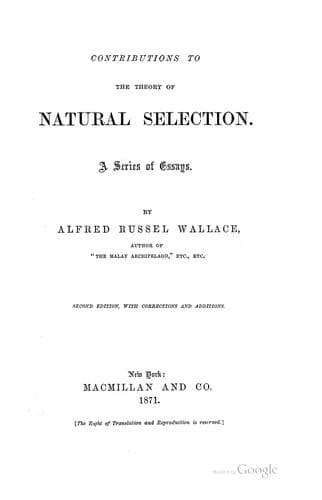
Contributions to the Theory of Natural Selection: A Series of EssaysWallace, Alfred Russel
Science
Contributions to the Theory of Natural Selection: A Series of Essays
Wallace, Alfred Russel
Natural selection
On this difficult point I have sought for information from some of our
best field ornithologists, but without success, as it is in most cases
impossible to distinguish old from young birds after the first year. I
am informed, however, that the males of blackbirds, sparrows, and many
other kinds fight furiously, and the conqueror of course has the choice
of a mate. Mr. Spruce's view is at least as probable as the contrary one
(that young birds, _as a rule_, pair together), and it is to some extent
supported by the celebrated American observer, Wilson, who strongly
insists on the variety in the nests of birds of the same species, some
being so much better finished than others; and he believes _that the
less perfect nests are built by the younger, the more perfect by the
older, birds_.
At all events, till the crucial experiment is made, and a pair of birds
raised from the egg without ever seeing a nest are shown to be capable
of making one exactly of the parental type, I do not think we are
justified in calling in the aid of an unknown and mysterious faculty to
do that which is so strictly analogous to the house-building of savage
man.
Again, we always assume that because a nest appears to us delicately and
artfully built, that it therefore requires much special knowledge and
acquired skill (or their substitute, instinct) in the bird who builds
it. We forget that it is formed twig by twig and fibre by fibre, rudely
enough at first, but crevices and irregularities, which must seem huge
gaps and chasms in the eyes of the little builders, are filled up by
twigs and stalks pushed in by slender beak and active foot, and that the
wool, feathers, or horsehair are laid thread by thread, so that the
result seems a marvel of ingenuity to us, just as would the rudest
Iinand hut to a native of Brobdignag. Levaillant has given an account
of the process of nest-building by a little African warbler, which
sufficiently shows that a very beautiful structure may be produced with
very little art. The foundation was laid of moss and flax interwoven
with grass and tufts of cotton, and presented a rude mass, five or six
inches in diameter, and four inches thick. This was pressed and trampled
down repeatedly, so as at last to make it into a kind of felt. The birds
pressed it with their bodies, turning round upon them in every
direction, so as to get it quite firm and smooth before raising the
sides. These were added bit by bit, trimmed and beaten with the wings
and feet, so as to felt the whole together, projecting fibres being now
and then worked in with the bill. By these simple and apparently
inefficient means, the inner surface of the nest was rendered almost as
smooth and compact as a piece of cloth.
_Man's Works mainly Imitative._
Public-domain text, read in full here on John Shaqi.
Reviews
Reviews
No reviews yet
Be the first to share your thoughts on this work.
Elsewhere in the archive
Join the Discussion
Join the discussion
Sign in to leave a comment or review.
Sign InorCreate an account