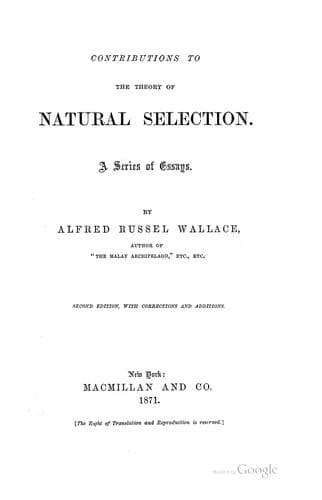
Contributions to the Theory of Natural Selection: A Series of EssaysWallace, Alfred Russel
Science
Contributions to the Theory of Natural Selection: A Series of Essays
Wallace, Alfred Russel
Natural selection
But look at civilised man! it is said; look at Grecian, and Egyptian,
and Roman, and Gothic, and modern Architecture! What advance! what
improvement! what refinements! This is what reason leads to, whereas
birds remain for ever stationary. If, however, such advances as these
are required, to prove the effects of reason as contrasted with
instinct, then all savage and many half-civilized tribes have no reason,
but build instinctively quite as much as birds do.
Man ranges over the whole earth, and exists under the most varied
conditions, leading necessarily to equally varied habits. He
migrates--he makes wars and conquests--one race mingles with
another--different customs are brought into contact--the habits of a
migrating or conquering race are modified by the different circumstances
of a new country. The civilized race which conquered Egypt must have
developed its mode of building in a forest country where timber was
abundant, for it is not probable, that the idea of cylindrical columns
originated in a country destitute of trees. The pyramids might have been
built by an indigenous race, but not the temples of El Uksor and Karnak.
In Grecian architecture, almost every characteristic feature can be
traced to an origin in wooden buildings. The columns, the architrave,
the frieze, the fillets, the cantelevers, the form of the roof, all
point to an origin in some southern forest-clad country, and strikingly
corroborate the view derived from philology, that Greece was colonised
from north-western India. But to erect columns and span them with huge
blocks of stone, or marble, is not an act of reason, but one of pure
unreasoning imitation. The arch is the only true and reasonable mode of
covering over wide spaces with stone, and therefore, Grecian
architecture, however exquisitely beautiful, is false in principle, and
is by no means a good example of the application of reason to the art of
building. And what do most of us do at the present day but imitate the
buildings of those that have gone before us? We have not even been able
to discover or develope any definite style of building best suited for
us. We have no characteristic national style of architecture, and to
that extent are even below the birds, who have each their characteristic
form of nest, exactly adapted to their wants and habits.
_Birds do Alter and Improve their Nests when altered Conditions require
it._
Public-domain text, read in full here on John Shaqi.
Reviews
Reviews
No reviews yet
Be the first to share your thoughts on this work.
Elsewhere in the archive
Join the Discussion
Join the discussion
Sign in to leave a comment or review.
Sign InorCreate an account